
Reimagining the Future of Sustainable Food: A Short Film on Agricultural Innovation
This post was written by Mara Klein as a part of their 2025 Lazarus Summer Internship.
At the beginning of this summer, the word “agrotech” brought to my mind gleaming robotic weeders, thermal remote sensing drones, and polished data maps overlaid on fields. My understanding of the future of agricultural innovation was influenced by an amalgamation of corporate websites, carefully aestheticized and flooded with greenwashing. I thought that the solution to agriculture was still in the works: miracle technologies being formulated to liberate farmers from our extractive, monocultural system and eradicate greenhouse gas emissions, chemical pesticides and herbicides, and fertilizer runoff. When I was first planning my independent project, I wanted to explore the science behind these technologies–how they interacted with the soil, the plants, and entire farm ecosystems.
I knew that I wanted to combine science and art to effectively communicate complex ideas to a wide audience. I also wanted to challenge myself and learn a new skill over the summer. So, I decided to delve deeper into journalism, which I had only briefly engaged with in the past, and introduce myself to the world of filmmaking. With the help of YouTube and a free subscription to Adobe Creative Suite, courtesy of Yale, I learned how to shoot footage, edit clips, and color-grade to achieve a cinematic look. I taught myself to hastily assemble a tripod, then stuffed it inside an Uber and carried it all the way to the Lockwood Experiment Station in Hamden for my first interview.
After speaking with Richard Cecarelli, the farm manager at Lockwood, I realized that a new angle might be in order for my film. As we sat outside in the summer heat, I listened to Cecarelli talk about the grim reality of most farming ventures: it is an incredibly risky profession, and even farmers who want to implement more sustainable practices often find themselves blocked by high startup costs or incompatibility with current equipment. Furthermore, Cecarelli pointed out that most farmers are already incredibly skilled at their work and able to perform tasks flawlessly and efficiently; therefore, new technologies must prove themselves before farmers are willing to invest in them and risk losing a crop. Furthermore, while automation can alleviate the back-breaking labor inherent in agriculture, some innovations run the risk of replacing human jobs. From my conversation with Cecarelli, I realized that agricultural innovation is a double-edged sword. The question remained: how can farmers test potentially helpful innovations while minimizing financial risk and other negative side effects?

Lockwood Experimental Station. Photo by Mara Klein.
Next, I spoke with Nat Irwin, a recent Yale alum and YSFP graduate. Before starting their current employment at Alameda County Recipe4Health, a food-as-medicine program, Nat worked with OpenTEAM for a little under three years. OpenTEAM, which stands for Open Technology Ecosystem for Agricultural Management, is a groundbreaking community of academics, agrotech specialists, farmers, and more. OpenTEAM focuses on open sourcing and data sovereignty as a way to empower farmers. When I asked Nat about their vision of agricultural innovation, they pointed out that farmers are constantly innovating on their own land: at its core, farming is perpetual problem solving and adaptation.
My interview with Nat reframed how I think about the future of agriculture. Many corporations push blanket solutions to overburdened farmers who are unwilling to adopt expensive, untested technologies. Open sourcing new techniques, management strategies, and technologies allows farmers to address the challenges that arise on their own unique plot of land, sharing their experiences and impressions with the rest of the ag sector.
Throughout my filming process this summer, I’ve realized that there is no shiny deus ex machina hiding in a corporate laboratory or website. Instead, farmers already have extensive expertise and insight—accumulated from years spent working with the land and intimately witnessing the effects of our changing climate. While certain technologies are undeniably beneficial for farmers, it is vital that we focus on amplifying the voices of farmers themselves, especially young, black, and Indigenous farmers that have been systematically silenced and excluded from agriculture. The key to improving our agricultural system is creating space for cooperation, empowering farmers to rely more on each other and less on exploitative corporations. The future of innovation in sustainable agriculture is rooted in collaboration, communication, and respect for ever-changing land and people alike.
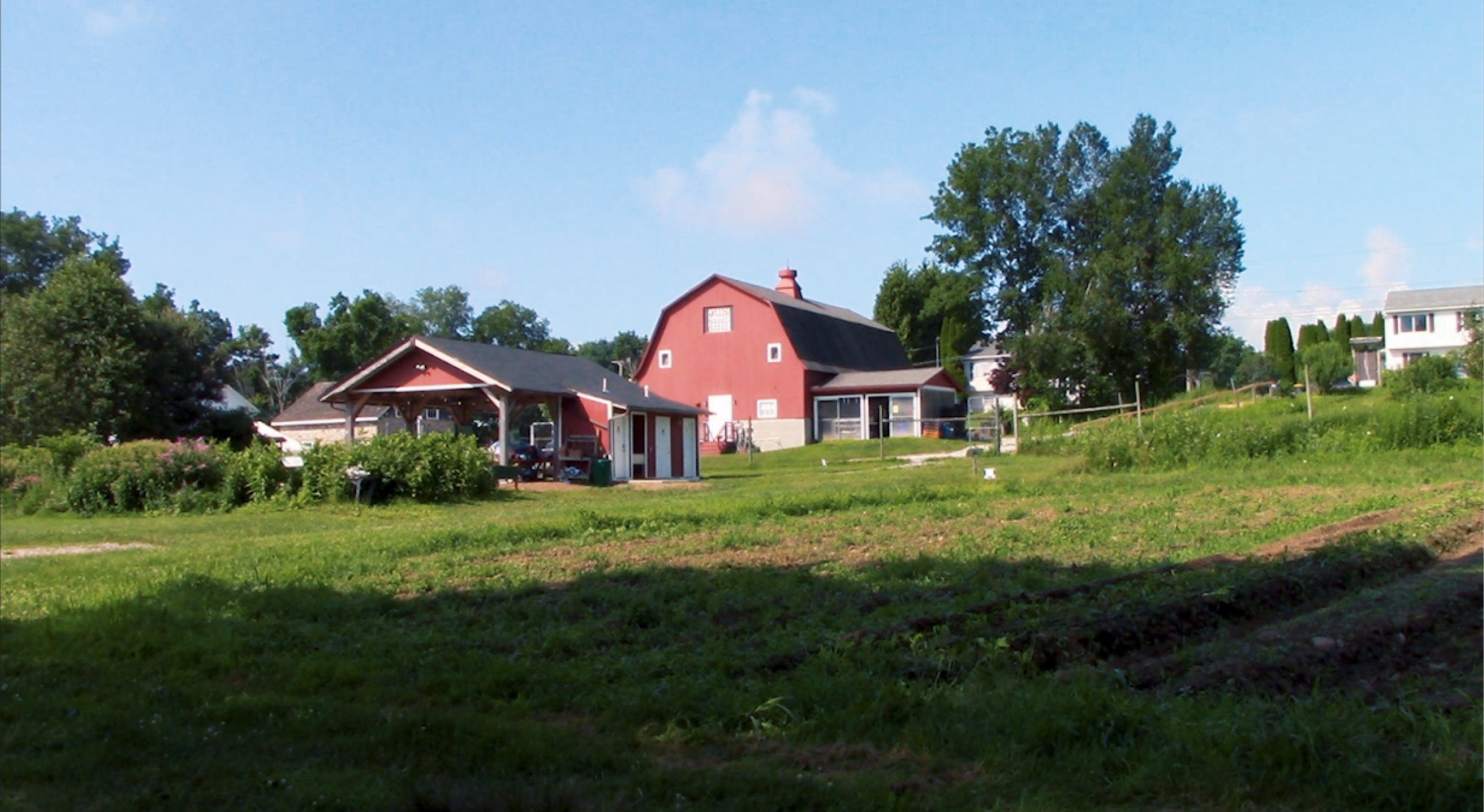
Massaro Community Farm. Photo by Mara Klein.
Mara’s film is not available online, but you can contact her at mara.klein@yale.edu.