Yale Sustainable Food Program

O’Shaughnessy Global Food Fellowship

Community-Based Food Justice Support in New Haven | GFF '25

Community-Based Food Justice Support in New Haven
This post was written by Meryl Braconnier as a part of her 2025 O’Shaughnessy Global Food Fellowship.

As soon as I parked the rusty van outside the senior center, it was game time—three hours of constant movement and flow, setting up the temporary farmstand for the eagerly awaiting customers. I focused on one motion at a time, in a chaotic dance with my two coworkers—open the trunk, set up the tents and tables, lug out the coolers upon coolers of vegetables, stack them high in rustic, wooden baskets, hang up our signs, turn on our pay station—all under the watchful gaze of dozens of elderly folks, with their walkers, canes, and wheelchairs, lined up against the dull beige bricks of the Bella Vista Senior Center. The front of the line had been waiting for nearly two hours, securing their primary selection of the local vegetables and fruit.

Residents at Bella Vista Senior Center lined up at the start of Common Ground’s Mobile Market on July 15, 2025. Photo Credit: Meryl Braconnier

Every Tuesday since mid-July, I’ve assisted with Common Ground’s Mobile Market—a farmstand on wheels that brings fresh, local, affordable produce directly to New Haven communities afflicted by food apartheid. Our diverse customer base contends with mobility, transportation, language, and financial challenges, on top of limited grocery stores, making it difficult, if not impossible, to access and afford local, nutrient-dense produce. The Mobile Market literally meets people where they live with cheaper, whole-sale prices, accepting federal benefits and offering 50% off purchases using the Supplemental Nutrition Assistance Program (SNAP), thanks to a matching donation from CitySeed, New Haven’s farmers markets organizer.

This summer, I furthered local food justice initiatives in New Haven, supported by the Yale Sustainable Food Program’s Global Food Fellowship and the Yale School of the Environment’s Carpenter, Leonard G. Fund. I split my time between Common Ground, an environmental justice charter high school, urban farm, and environmental education center, and Gather New Haven, the nonprofit that manages the city’s 40+ community gardens and offers community development programming.

During this practical, on-the-ground experience, I considered how to increase access and connection to healthy foods and nature through Common Ground’s Mobile Market and community gatherings. I also explored a new community engagement strategy with Gather New Haven’s garden network: the NYC Urban Field Station’s Stewardship Salons.

From Field to Feast: Increasing Food Access in New Haven

Through heat waves and rain, I assisted with all aspects of Common Ground’s vegetable production from planting to harvest and helped manage their Mobile Market outreach and delivery. Our farm team raked, shoveled, mulched, weeded, pruned, harvested, and sweated. Under our attentive care, our diverse crops, like kale, tomatoes, parsley, and beans, flourished on the 1-acre site. Urban growing spaces, like Common Ground’s farm and Gather’s community gardens, are largely constrained by size, soils, and resources. Their beauty and bounty radically resist our country’s cracked, inequitable systems of food production, distribution, and consumption, offering healing experiences and nourishment.

2025 farm intern team at Common Ground posing by freshly prepped beds for winter squash plantings. From left to right: Isabela, Linda, Pauline, Ethan, and Meryl. Photo Credit: Diane Litwin

With the Trump Administration’s devastating cuts and rollbacks in funding for environmental justice and food access programs, Common Ground was unable to hire a Mobile Market manager for the 2025 season. Thankfully, my coworker Ethan Reynolds and I received Yale funding to carry on with the Mobile Market’s 14th season.

Although our capacity was limited—dropping from the typical 5 stops per week to 1 stop per week—we held seven Mobile Market stops from June to August, split between the Bella Vista Senior Center, Cornell Scott Hill Health Center, and the Towers at Tower Lane, senior living community. At those seven, two-hour stops, we serviced nearly 350 customers. About 60% of our customers purchased their produce with federal benefits from the Farmers Market Nutrition Program (FMNP) for low-income seniors or for nutritionally at-risk women, infants, and children.

Myself and my coworker Takeira assisting a Tower 1 resident with her joyful kale purchase. Photo Credit: Karisma Quintas

All the fruits and vegetables sold at the Mobile Market are grown at Common Ground or on Connecticut farms within a 20-mile radius of New Haven. The Yale Farm donates crops when they have a larger harvest. The Mobile Market upholds a dignified dimension of food access work: ensuring people can eat healthy, high-quality foods that are relevant to their culture. I see the vital need for the Mobile Market in the long lines of customers waiting at nearly every stop and in the smiles on people’s faces when they share how they plan to prepare their fresh produce.

Stewardship Salons: Connection to Action to Resilience

In collaboration with Zion Jones, Gather’s Community Engagement Coordinator and Environmental Educator, and with the support of the NYC Urban Field Station, we developed and hosted six Stewardship Salons, facilitated by diverse community leaders, on the topics of safety on the urban farm, compost management, fermented DIY fertilizers, communal gardening values, local indigenous histories, and building sacred relationships with the land. Through my organization, creativity, and communication, I provided Gather New Haven with a transformative, community engagement model that helped them build connections to their communities and other social justice groups and facilitators.

Stewardship Salons are collaborative co-learning spaces where participants engage with place-based topics and exchange knowledge, building individual and collective capacity to care for natural resources, land, and communities (Stewardship Salon Guide, 2024). The Stewardship Salon framework emerged from a 2017 workshop titled “Learning from Place” hosted by Native Hawaiian master teacher, Kekuhi Kealiikanakaoleohaililani, bringing together Hawaiian and NYC stewardship practitioners. Since 2017, the NYC Urban Field Station (USDA Forest Service and NYC Parks Department) have hosted over 30 Stewardship Salons for the personal and professional development of their diverse stewardship practitioner network.

The workshops provided safe spaces for an open dialogue amongst gardeners, garden managers, and community members, catalyzing action through connection. Through our Safety on the Urban Farm salon, Gather staff and board members met Carmen Mendez of New Haven’s Livable Cities Initiative. Within a week of the salon, Mendez helped fulfill a priority safety measure for Ferry Street Farm in Fair Haven: installing flood lamps on the telephone poles looking over the growing space.

Gather's first Stewardship Salon, Saftey on the Urban Farm, at Ferry Street Farm in Fair Haven on July 9, 2025. Facilitated by Sadiann Ozment, a Gather NHV Board Member. Photo Credit: Meryl Braconnier

At our salon on Communal Gardening and Gather New Haven’s values hosted by Nadine Horton, founder and manager at the Armory Community Garden, we brought together 10 garden coordinators who oversee the volunteers and growing activities at Gather’s dispersed garden sites. This listening session provided a rare yet essential opportunity for the garden coordinators to get to know each other and share knowledge, fostering resilience between the urban growing spaces. One main outcome was the plan to create a shared communication channel, via Slack or Discord, for the garden coordinators to stay connected.

Following the salon, one of the participants emailed us with gratitude:

“Thank you all for organizing this salon with a joyous spirit and generous hospitality. [In my opinion,] it was much needed on so many levels: 

·       reinforcing/building relationships among garden leaders. 

·       having a say in the future focus and sustainability of this organization. 

·       visiting the lovely possibility of what could be as set by the Armory garden.”

Nadine Horton facilitating a conversation on communal gardening values with Gather's garden coordinators on July 19, 2025 at the Armory Community Garden. Photo credit: Meryl Braconnier.

The Stewardship Salons on Compost Management and Korean Natural Farming (KNF) provided folks with the skills and knowledge to maintain their own garden spaces through regenerative practices. At the KNF Salon facilitated by Gather’s executive director, Jonathón Savage, 19 participants weeded Mugwort (Artemisia vulgaris) from an overgrown garden bed, stripped the leaves into shared bowls, and massaged the fragrant leaves with brown sugar. Everyone took home some of the communal mixture, packed tight into glass jars covered with paper towels, to ferment into a low-cost, DIY plant amendment.

The final two workshops on Local Indigenous Histories and Building Sacred Relationships with the Land inspired deeper connections to place through historical context and meditative offerings of thanks to the earth. Guided by Clan Mother Shoran Waupatukuay Piper and Babalawo Enroue Onígbọ̀nná Halfkenny, I left small tokens of gratitude by the banks of the gurgling West River: lavender, tobacco, walnuts, and a slice of tomato.

As I gave my offerings, I lifted my gaze to meet the steady, glowing gaze of West Rock, illuminated by the setting sun. I thanked the cliff for watching over me this summer as I built relationships with Common Ground, Gather, community members, and the land, helping to feed my neighbors and build upon the deep, rich topsoil of community-driven, food justice initiatives in the Elm City.

Acknowledgments

Thank you to the Yale Sustainable Food Program’s Global Food Fellowship and the Yale School of the Environment’s Carpenter, Leonard G. Fund for making my summer financially possible.

Thank you to the farm team at Common Ground, Deborah Greig, Diane Litwin, and Victoria Zucco. Thank you to Gather New Haven’s executive director, Jonathón Savage, to Zion Jones, and to the Farm Based Wellness Program coordinators, Ruth Torres and Celin.

Thank you to the Stewardship Salon facilitators, Sadiann Ozment, Nadine Horton, Takeira Bell, Jonathon Savage, Clan Mother Shoran Waupatukuay Piper, and Enroue Onígbọ̀nná Halfkenny.

Thank you to the NYC Urban Field Station team, especially Neha Savant and Lindsay Campbell, for your mentorship and guidance.

Farmers, Cattle, and the Colorado River Crisis | GFF ’25

Farmers, Cattle, and the Colorado River Crisis
This post was written by David Rosenbloom as a part of his 2025 O’Shaughnessy Global Food Fellowship.

This summer, I traveled to Colorado as a Global Food Fellow to speak with those working on the future of agriculture in an increasingly water-scarce West. With an agricultural sector dominated by beef and dairy, Colorado embodies how water-intensive agricultural sectors along the Colorado are navigating today’s challenges and tomorrow’s uncertainties. I set out to learn how policymakers are balancing environmental concerns with the economic self-determination and cultural legacies of agricultural communities, what conservation initiatives are taking root on farms, and how different stakeholders view the future of Colorado agriculture.

—

A storm is brewing over the Colorado River. Its sources are many: chronic overuse engendered by a 1922 compact that allocated water among the seven basin states on the basis of unusually wet early-20th-century data; explosive population growth across the arid West, placing some forty million people dependent on the river today; a run of exceptionally promising snowpack in the 1980s and early 1990s that gave the illusion of abundance one last breath; interim management guidelines adopted in 2007 that did little more than delay an inevitable reckoning with scarcity while water levels continued to decline; and, above all, a twenty-five-year, climate-change-intensified megadrought, the most severe in the basin in over a millenium, that has reduced flows by 20% from their long-term average. The result: there’s no longer enough water to go around – allocations still promise about 15 million acre-feet a year, but the river now delivers barely 12, and projections warn of an additional 20 to 30 percent decline by mid-century.

The 2007 guidelines are set to expire after 2026, and representatives from the seven basin states have been convening to decide the future of water in the region. At the heart of these negotiations lies agriculture. The most detailed accounting of the Colorado’s water use to date, a 2024 article published in Communications Earth & Environment, found that irrigated agriculture consumes 52 percent of the basin’s total supply and 74 percent of all human use. Of the river’s agricultural share, nearly two-thirds are devoted to crops, such as alfalfa and other hays, used to feed beef and dairy cattle.

In Colorado, one thing became immediately apparent to me: everything – or almost everything – revolves around seniority. Colorado follows the prior appropriation doctrine, which means water rights are not tied to land ownership but to who first diverted water and put it to “beneficial use.” In times of shortage, the State Engineer and local water commissioners administer water according to priority: senior users can call for water, and junior users upstream must reduce or stop their diversions until the senior right is satisfied.

Colorado farmers, in general, hold 19th-century or early 20th-century rights; in contrast, transmountain diversions supplying Front Range cities usually have mid-20th-century rights, making them junior. The upshot: if there isn’t sufficient water in the river to satisfy all users in the state, the priority system dictates that urban centers like Denver, Boulder, and Colorado Springs would be among the first to be cut off.

Facing an increasingly uncertain water future, I discovered that these municipalities have thus been incentivized to engage in “buy and dry” schemes: purchasing farmland and/or senior water rights and taking the land permanently out of production to ensure enough water is available for the cities. But farming communities tend to be resistant to these types of initiatives. Philip Womble, an attorney and hydrologist specializing in water policy and water markets, underscored to me the nature of this opposition: “these concerns must be understood as concerns around the social and cultural impacts on these communities [...] of external actors resulting in less and less agricultural land being farmed.” For Brian Richter, president of Sustainable Waters, a global water education organization, this is completely understandable: “Paying a bunch of farmers for their land or water rights [...] starts to tear at the fabric of rural communities. Because if you have a third of the farmers no longer growing crops in a place like Grand Junction or, you know, Yuma, then you don't have as many people showing up in the restaurants, you don't have as many people buying new cars. You know, there are, there are good examples in the west of how small rural communities got decimated because too much reduction in agricultural water use took place. And so the agricultural communities are very defensive, very resistant to allowing that to happen.”

The reality, though, is that water is unlikely to be turned off to the big cities any time soon. As Douglas Kenney, Director of the Western Water Policy Program at the University of Colorado Law School, put it to me: “you're not going to be growing alfalfa in western Colorado while Denver runs out of water.” As alternatives to “buy and dry” scenarios, then, stakeholders in Colorado have been increasingly turning towards initiatives that improve water conservation on farms without infringing upon the social and economic foundations of rural communities.

One such initiative that kept on coming up in conversations is the System Conservation Pilot Program, run by the Upper Colorado River Commission in partnership with the four Upper Basin states. First implemented between 2015 and 2018, the program compensates farmers for voluntary and temporary reductions in water use, primarily through producers fallowing parts of their fields.

Despite some promising figures from this first trial – 64 projects implemented, an estimated 51,000 acre-feet less of water used by participating farms – the program’s raison-d’être wasn’t entirely clear. The water conserved by participating farms was not taken out of use entirely: as a policy expert at the Colorado River Water Conservation District told me, “Ideally, if you are going to do a program like this, you would want to put this water that's conserved somewhere so that you can use for compact compliance…But the Pilot Program doesn't do that. If someone conserves water, that water continues to go downstream. Someone immediately downstream from that person can use that water for whatever they want.”

Chuck Cullom, Director of the Upper Colorado River Commission, admitted to me that these are valid concerns, which is why UCRC has taken a different approach for the second iteration of the program, which launched in 2022. Rather than fallowing their land, farmers in the program are now encouraged to invest in new tools for drought resiliency that they likely wouldn’t otherwise attempt trying. As he explained, “Farming is a risky endeavor because of the vagaries of markets, costs and hydrology … but if you can offset their risk for new endeavors, new approaches, new crops, then you'll have a lot more takers.” With over 60 contracts agreed to in 2023 and over 100 in 2024, Cullom believes his team has demonstrated not only the “appetite for producers to develop their own local drought resiliency tools,” but also the untapped potential of on-farm conservation initiatives: some farmers decided to take a field out of production tor rehabilitate infrastructure, others tried new alternative forage crops like triticale, while still others opted to try out different soil health treatments.

Unfortunately, though, Colorado producers have not been able to participate in this new iteration of the program. In 2021, the Colorado River Water Conservation District put forth an argument that conservation was not a “beneficial use” of watering, and soon after the State Engineer concurred. The result, as Anne Castle explained, is that “in Colorado we have adopted the legal position that conservation of water is not a beneficial use,” meaning farmers risk their rights if they accept payment to use less.  

But the SCPP – which has been halted since its reauthorization bill stalled in the House this session – isn’t the only mechanism through which Colorado farmers are being encouraged to explore conservation initiatives. Kate Greenberg, Colorado's Commissioner of Agriculture, has been pushing for investments within the state that recognize the need to adapt to the times: the STAR soil health program, first launched in 2019 and now expanded through the federally backed STAR Plus initiative, pays producers to adopt practices like cover crops, reduced tillage, and crop diversification; the state’s Drought and Climate Resilience Office, created in 2021, coordinates agencies and provides planning tools for water-scarce regions; agrivoltaics research and demonstration projects, supported by a $500,000 state grant program in 2023, tests, for example, how solar arrays can be paired with grazing systems and crop production; and the Climate Smart Market Expansion Project, launched in 2025, helps producers who invest in climate-friendly practices reach new markets through grants of up to $90,000. These initiatives reflect, as

Commissioner Greenberg told me, that those in Colorado’s Department of Agriculture are committed to “looking for ways to keep farmers on the land, to keep folks in production…providing incentives to produce in a way that's more environmentally sustainable and meets the real environmental conditions of our time.”

Some, however, argued to me that the problem is too large to be solved by these types of initiatives. Richter, for example, pointed out that since the Inflation Reduction Act, the federal government has been paying roughly $1.3 billion per year for farmers to temporarily fallow fields or reduce water use, and that even at that scale, it has only covered about one-third of the conservation needed to balance water demand with supply. “The temporary thing,” Richter told me, “is untenable. It’s an unworkable solution. We’re not going to keep approving more than a billion dollars a year…There has to be new strategies put on the table, and they're gonna be very difficult for the agricultural community to swallow and agree to. But there's no way in the world you can save the river system and prevent catastrophe without doing it.”

Kenney agrees. In our meeting, he emphasized that changes in technology, in terms of net consumptive changes, doesn’t make nearly a big enough difference. The tradeoff, between, on the one hand, taking serious steps for conservation by taking land out of production, and, on the other, the devastating cultural, economic and social impacts that this has, was the focus of our nearly hour-long discussion. If the river system isn’t to be completely decimated, “agriculture is not going to come out of this happy,” he told me. Ultimately, for Kenney, the question is whether in the interest of conserving the river, “we as a society are comfortable with the effects that moving away from water-intensive farming sectors will have.”

– 

The storm over the Colorado is only growing darker, and the future of agriculture in the West lies directly in its path. As Richter warned me, “this could very likely turn into the biggest water crisis in human history, and it's coming at us at a frightening speed.” Whether the seven states summon the will for serious reforms or continue to defer the hardest choices remains to be seen. But, as I learned this summer, when the reckoning arrives, the agricultural landscape of the West will be profoundly transformed.

Returning to the soil: Gardening as form of embodied knowledge | GFF ’25

Returning to the soil: Gardening as form of embodied knowledge

This post was written by Bendy Sohn as a part of his 2025 O’Shaughnessy Global Food Fellowship.

For two weeks, I embarked on a journey of discovery, memory, soil, and gestures. This research began as a personal quest to learn how to farm from my father virtually. I aimed to uncover the lessons that were lost within those constraints. My father is a subsistence farmer and deacon in Liberia, and I wanted to learn from him not just through words, but through the quiet, embodied knowledge that is passed down from hands to land.

As a child of Liberian migrants, I’ve often felt the weight of distance—cultural, emotional and geographical. This fellowship is an avenue to attempt to close that gap, I wanted to not just witness but how my father taught, through tools, gestures, repetition and unspoken understanding. and my research asks: How Liberia’s indigenous farming practices facilitate the transfer of knowledge across generations?  What gets passed down when we plant together, dig together, sit with the land together? My project lives in that space—between adaption, memory, labor, and care. 

My approach to answering my research questions was based on presence, repetition, and relational learning. Instead of collecting data in a traditional sense, I aimed to reconnect, observe thoroughly, and learn through experience and reflect. I understood clearly that my father's knowledge was not only found in the words he spoke but also in the consistent actions he carried out. 

Arriving in Liberia in early August during the rainy season posed some challenges, as there were only a few days each week when the rain was light or absent. My father suggested that certain plants would thrive in this climate during that time. Navigating the rain—both working against it and with it—taught me the importance of patience as I waited for the downpour to subside before heading to the site. Before we began any activities, we created a schedule to help us stay organized and focused on our responsibilities and goals.

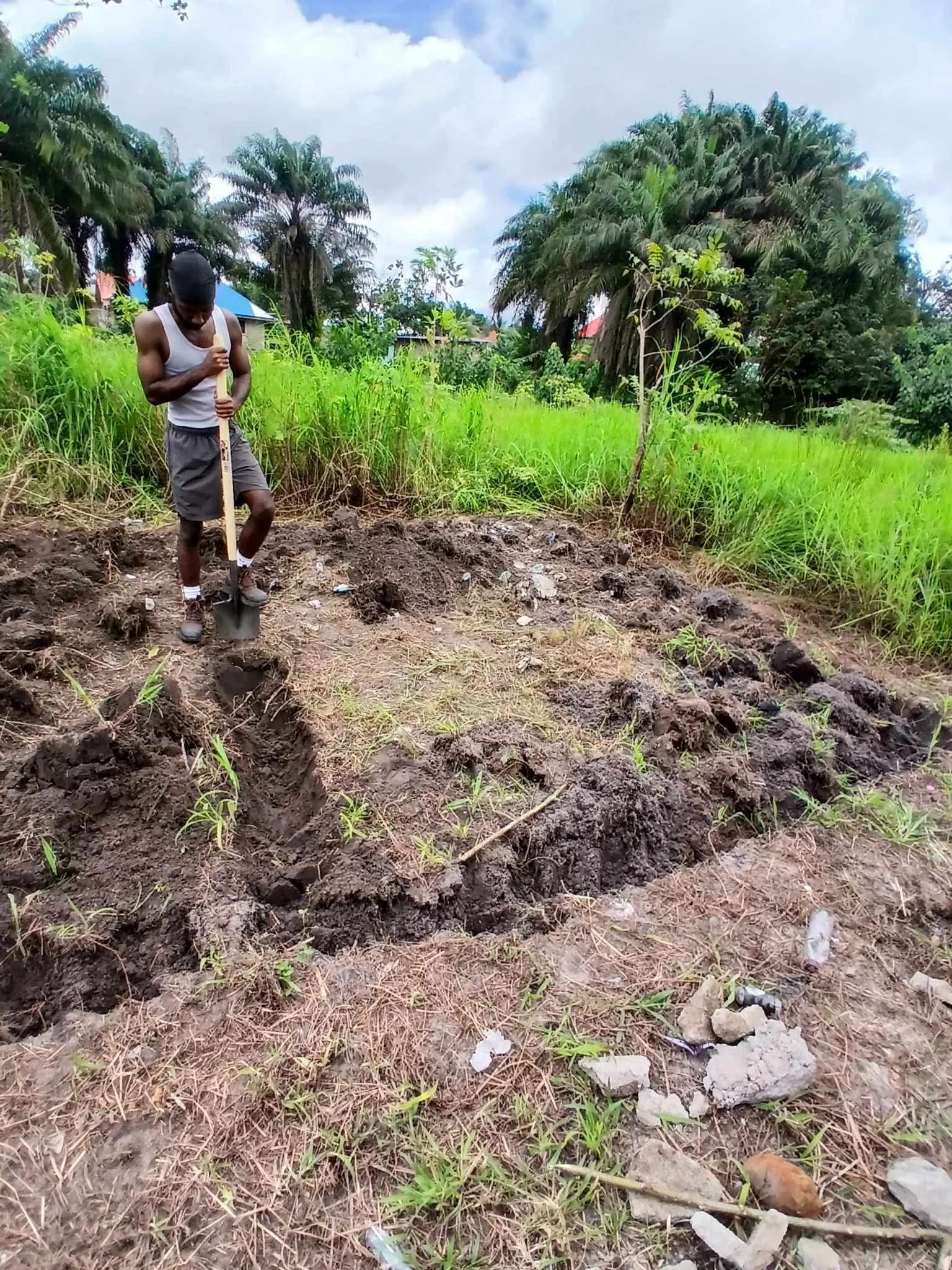
My father took me to his land, a vast area of greenery surrounded by a giant palm tree. We surveyed the land and mapped out how much we wanted to clear for our project. The following day, we set out to find all the materials we would need. My father suggested we gather a hook, a shovel, a pair of boots for him, a rake, and a machete. He specifically suggested one of each tool, as he wanted us to share the responsibility by taking turns.  After collecting the tools, we visited his neighbors to trade seeds. For the seeds we couldn't find, we went to an informal farmers' market, where a wide variety of seeds were available at affordable prices.  The seeds we collected were for water spinach, okra ,and palava sauce. These three plants my father would plant during the rainy season. During our time together that day, my father asked me about my connection to land in the United States. I struggled to find an answer since I didn't have a direct connection. He then advised me to create one, explaining that learning how to farm or garden is an essential part of being self-sufficient as an individual. He emphasized the importance of knowing where our food comes from and how it gets to us. Later that day, I wonder how my food gets to me before I digest it? Who planted it and how long did it take to harvest ? I reflected on how I did not have a connection to land in the U.S and chasing for one in Liberia. 

Photo by Bendy Sohn

The following day, I visited the site with my father and brother. Before we started any work, we took a moment to pray.  We then began the task of brushing and clearing the land. I found this process very challenging. My father started brushing and demonstrated the technique for me. He worked for a few minutes while I watched closely. I observed that clearing was a technique-based action; from his form, it was evident that the motion was consistent and thorough. Although the action seemed simple, I quickly learned that it was less about physical strength and more about technique and endurance. I felt a sense of insecurity because I did not perform at the same speed and efficiency as my father. He reminded me that my body hadn't fully grasped the task yet. I wonder what it means for physical labor to be not only seen as a task but also as a form of knowledge. This shifted my understanding of gardening, as digging, clearing, and planting became languages of experiences I was not familiar with and will require more repetition to grasp them. 

As I worked through the tall grasses, I used a hook we fashioned from some found wood to gather and direct the cut grass to a specific spot on one side. I quickly realized how important it was to work efficiently, but I also felt the strain on my back from the repetitive movements after just a few minutes. The grass seemed to weigh more the deeper I went into it. My father reminded me that making sounds would help keep up our motivation as we tackled the clearing. We teamed up to clean the area, taking turns in a rotation: first my father, then me, followed by my brother. Together, we decided to set up three garden beds, each designed for different seeds.

In the following days, we focused on digging walkways between each garden bed. These walkways were designed to separate the plants and allow us to observe their growth more easily. We then turned over the rich soil, noting its dark and milky appearance, which indicated its high nutrient content. Using a shovel, I lifted and turned the soil while my father leveled it with a rake to create an even surface. Once we had prepared the soil, my father cut small branches from a nearby tree to mark the spots where we planted the seeds. This technique helped us keep track of where each seed was planted. We then began making signs for each garden bed and started planting the seeds in their designated areas, making sure to space them out from one another. For the palava sauce seeds, my dad noted that they need to be sprinkled on the soil instead of being buried like the other seeds. We then proceeded to put the stick over the seed we buried in the soil. How long would it take for these seeds to harvest, since it is the rainy season would the climate disrupt the growth ? These questions ponder my mind. 

During this productive week, time seemed to slow down, and my understanding of land, labor, and place changed. I had always viewed labor as a means to complete a task, but while gardening, I realized it was more of a struggle that required me to slow down. I needed to focus not just on finishing the task but also on appreciating its significance to my roots. And also how I learned that “doing something right” should not be my primary concern; instead, allowing myself to be patient and open to learning was far more valuable. Land to me was seen as something I just admired from a far, but nearly interacted with closely, through my observation land became a living archive of memory, labor and belief. 

I left Liberia with new knowledge of gardening, a routine that involves care, rhythm, repetition and intergenerational resilience. It also involves adapting to climate changes as it works hand in hand. What was passed to me can’t be held in a notebook—it lives in the gestures that were enacted along by my father, the challenges within the gestures were a learning moment along the ones that were semi familiar.


Photo by Bendy Sohn