
This post was written by Maya Foster as a part of the 2026 O’Donohue Family Fellowship Award.
On the far side of Stanford University's campus, tucked between golf courses and horse riding fields, sits The O’Donohue Family Stanford Educational Farm: a living laboratory, a stakeholder in the university's food system, and a working model for the future of agriculture. Established on six acres, The Farm organically produces a bounty of edibles, florals, and students of sustainable agriculture.
I grew up around farms, but in the form of the large scale orchards of cherries, peaches, and mulberries, with signs at the city lines proclaiming our town as the “U-Pick Capital”. At Yale, I’ve spent two years speaking to chefs and ecologists alike on Snacktime, a YSFP Radio Hour, and talking with students about the work happening on The Yale Farm to report in the weekly YSFP newsletter. Yet, I had never done that work myself beyond lending a hand here and there. Those conversations at Snacktime pulled me toward agroecology and small-scale farming, toward wanting to build something with my own hands instead of just writing about other people building it. I followed that inclination to the O’Donohue Family Stanford Educational Farm, where I could finally be inside the work, not describing it from the outside.
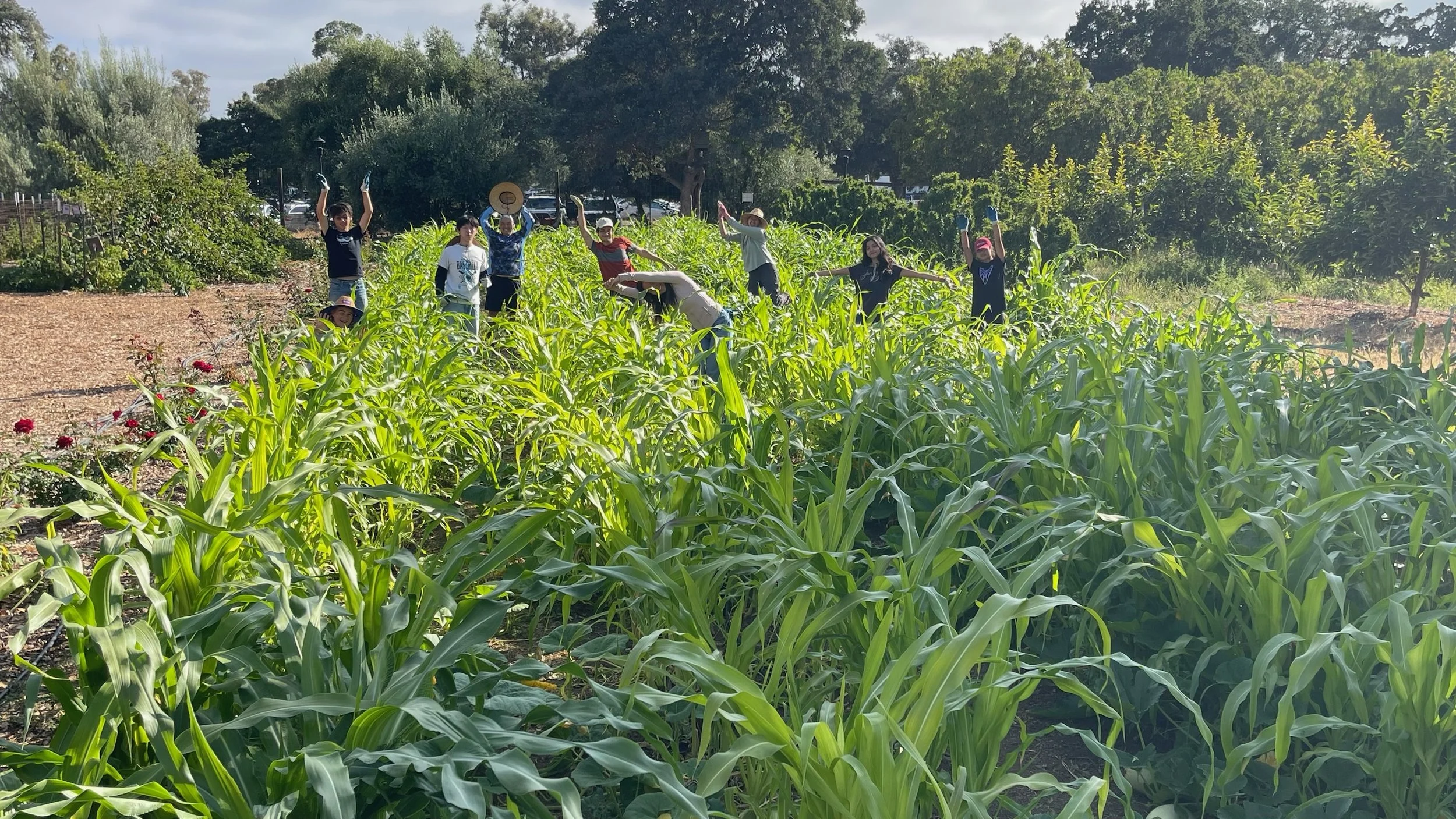
The first time I walked onto The Farm, it felt like stepping inside a living organism: a system in constant motion, cycling through growth, death, and rebirth. That week, we harvested flowers for bouquets and dried bundles, planted squash, arranged flowers for delivery across campus, weeded and mowed the beds, led thirty-or-so volunteers through a vegetable harvest, made pesto and pickles, seeded amaranth into trays, and on Saturday I led a crew through field maintenance.
I had arrived with a simple idea of what that work would be. To me, agriculture was a straightforward process, something to optimize and maximize the resiliency and efficiency of. I imagined meticulous processes and a fixed order of operations, everything running as theoretically planned.
I began to reassess my predispositions during the beginning of my time in Palo Alto. During my stay, I resided in an intentional cooperative community called Magic Inc., and the fellows there introduced me to a concept they had coined: “valuescience”. They explained the philosophy as connecting value and science through prediction, using what we can anticipate to make meaningful choices toward a satisfying end. The idea initially struck me as abstract, yet self-evident at its core, as though it scarcely needed explanation. It was not until I found myself cradling a bushel of statice stems or digging my hands into the soil at Stanford Educational Farm that I understood its implications. Agriculture is an ongoing process of creating value by making, testing, and revising predictions.
The Farm gave me countless opportunities to test that idea in practice.
Sometimes, tying tomatoes to a trellis helps them climb, only for the same intervention to spread a fungal disease that clogs their water-conducting tissue and leaves them wilting. Sometimes, leading volunteers into the fields on a hot summer morning to pull bindweed ends with morale collapsing and the group dispersing just as you return with the wheelbarrows. Allison and Will, The Farm Facility and Production Coordinators, taught me to treat each experience as something to learn from and carry into the next attempt, making it a little more efficient, a little more informed. Will mentioned once that he’d stopped believing in a set pattern and “best practice” long ago. Sometimes, you have a bountiful carrot season, and the next time you do the same thing under the same conditions, and it takes detective work to find a few carrots. Or maybe you do everything “wrong” and the squash thrives anyway. The dirt doesn't care how carefully you follow the plan, it just does what it's going to do, and you're left standing there, learning to be okay with that.
In that first week, Patrick Archie, the Farm's director, walked me through the beds set aside as a medicinal herb garden with the beginnings of Native American, Chinese, and Ayurvedic plantings. I knew immediately I wanted a hand in growing it. Every plant there carried a weight of cultural meaning I was only beginning to understand. For each of the three sections, I compiled a list of potential herbs and, using what I could learn about their water, sunlight, and spatial requirements, selected the plants I thought were most likely to thrive in their new beds. I planted grindelia, a bright-yellow wildflower traditionally used for respiratory and skin ailments; tulsi, a basil widely used in Ayurvedic medicine for its range of therapeutic applications; and Navajo tea, or greenthread, which is brewed as a tea with anti-inflammatory properties. For generations, people have learned from these plants and aided ailments of all sorts, simply from experimentation. In the garden, each planting was a prediction, or maybe a prayer, of how a particular plant would respond and add value to a particular place.
Gardening, of course, quickly reveals the limits of prediction. Sometimes the soil is so dense and clay-rich that water pools on its surface. Sometimes a plant you have carefully tended is broken and stripped bare in a single day. Each turn requires you to reconsider what you thought you knew about the soil, the plant, or the conditions around it. But the uncertainty is what makes it fun!
I'd started the summer with a vague ambition to understand and contribute to The Farm's water systems. The mechanisms felt distant and mechanical, all pipes and pressure. As I settled into the rhythm of The Farm, I went searching for water and landed on the soil-moisture sensors, the small probes buried underground to guide efficient irrigation. Inspired by the work being done at the UC Santa Cruz Center for AgroEcology by Crystele Leauthaud and Colleen Josephson, I began working with sensors on The Farm that had yet to be put into use. I learned that the two devices embodied different approaches to answering the same question. The Ecowitt sensor works by capacitance as it sends a signal through the soil and reads how the dielectric constant shifts with water content, then beams that reading wirelessly to a base station. The Irrometer works more indirectly, tracking the electrical resistance between two electrodes embedded in a granular matrix that slowly equilibrates with the moisture around it. Each offered a different way of observing a system that was constantly changing. I began to see water not as something simply delivered through pipes, but as something that moved, pooled, drained, and lingered in ways I could only understand by testing, observing, and adjusting.
Water, it turns out, is its own unpredictable compound. Halfway through the summer, I wanted to bring a piece of home to The Farm, so I brought a jasmine because I grew up with a huge jasmine bush in my front yard. With the help of Will, I hauled a large ceramic planter pot out and drilled a hole in the center. I filled it with soil and compost, transplanted the jasmine, and rigged the irrigation emitter the same way I had for every other bed that summer. My prediction seemed straightforward as the same irrigation system that sustained The Farm’s other plants would sustain this one. Two days later, the pot was overflowing with water and my jasmine was floating at the top of a dirt soup. So we added dry garden soil to absorb some water, let it sit in the sun, and the next week I came back and spent two hours drilling more holes, ending up with a grand total of four holes. It felt like a small, absurd monument to the whole summer: something I planted with care, nearly drowned by the very system meant to sustain it, saved only by patience and a willingness to keep drilling.
Patrick, Will, and Allison had developed The Farm as a way of relating to the land that did not begin with the assumption that it could be fully understood or controlled. Their approach was rooted in agroecology and sustainability, but also in a more fundamental willingness to work through uncertainty rather than eliminate it. I had arrived thinking that agriculture was largely a matter of getting the inputs right: water, soil, plants, labor. I left understanding it as a practice of continual observation and revision.
I think about that distinction now as I enter into a new cycle at the YSFP this year. Some days, the most meaningful experiment is a sensor reading or a planting bed. Other days, it might be standing in the wash and pack, hands sticky with squash, turning a candy roaster into a pie. Both require the same willingness to learn from what happens next. The O’Donohue Family Stanford Educational Farm taught me that meaningful work does not depend on eliminating unpredictability, but on developing the patience and judgment to experiment within it. I no longer expect the answer to match what I imagined. I've just gotten better at listening for it, and starting again from wherever it leaves me.