

An American in Paramaribo: Biodiversity Conservation and A Voyage Into Surinamese Maroon Culture Through Food
This post was written by Maia Simone Roothaan as a part of her 2025 O’Shaughnessy Global Food Fellowship.
I spent this past summer living in Paramaribo, Suriname, the most forested country in the world. Suriname is also the only country in Latin America where Dutch is spoken, being a former colony. In my three months there, I found myself surrounded by many other languages, including Sranan Tongo, Saramaccans, Spanish, Portuguese, and French (the other language which I speak.) Suriname is a country of rich diversity, in language as I’ve explained above, but also in ethnicity, religion, landscape, and of course, food.

August 7, my last visit to the CI office where my coworkers bid me farewell with a lunch of saoto soup.
While Suriname is technically not an island, it tends more towards its Caribbean island neighbors, culturally. The Maroons are one of the largest ethnic groups in Suriname, just over 20%. They escaped slavery into the forests of Suriname; much of their African culture and language is still preserved because they have continued living in their own forest villages. Through my work as a legal intern at Conservation International, I had the opportunity to visit several Maroon villages, enabling me to connect with their culture through food.
My first visit was to Brownsweg to observe the opening of a community agroforestry school to help the community with food sovereignty efforts. For a long time, they have been reliant on having produce and other products driven in from the city, Paramaribo. This project was being sponsored by Total Energies, the third largest oil company in the world, who have just launched a new drilling project off the Surinamese coast. On our two hour drive back, my colleagues and I enjoyed lunch we bought from a Javanese restaurant by the roadside–I had a traditionally vegan dish made with rice that is pounded into cubes, fried tofu, bean sprouts, and spicy soy sauce. The Javanese first came to Suriname as indentured labourers, and they make up 15% of the population.
We were led to the meeting center in Pikin Slee after disembarking our canoe.
My second work voyage to the interior was a three day trip to Pikin Slee which involved several hours by bus and then by boat down the Suriname River. I was observing the culmination of a project done as a part of CI’s African Descendents Program. We had a meeting with many of the villagers, the chief, and CI staff to reflect on work being done to provide women with upward economic mobility through the monetization of traditional agriculture crops, primarily cassava and peanuts. I think Surinamese people like peanut butter even better than Americans; for lunch I had sweet peanut soup with cassava bread and cassava/peanut cake. There were other things, but they were all meat, so I couldn’t eat them. Dinner back at our accommodation consisted of savory peanut soup and bakabana (fried plantain with peanut sauce.)
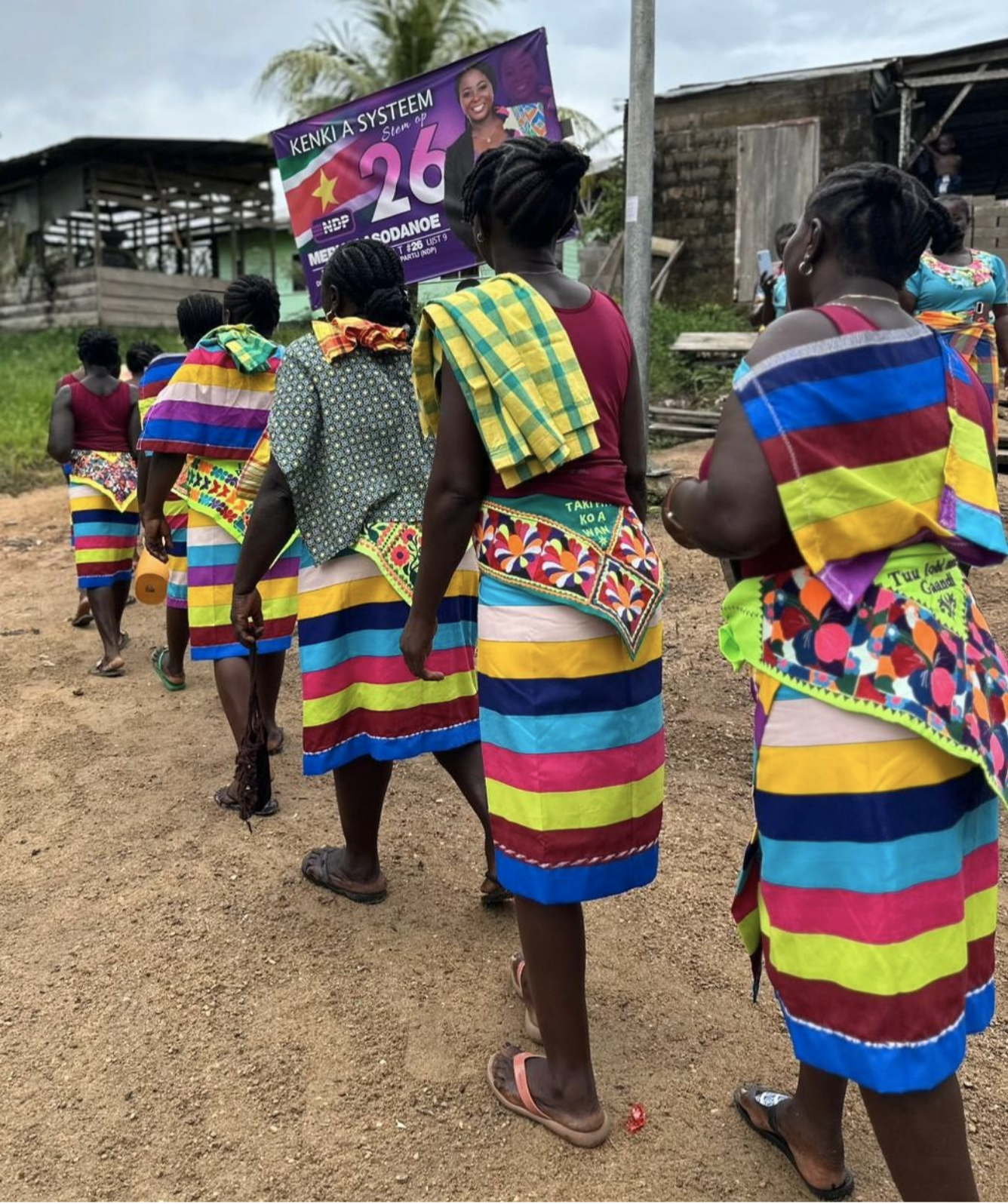
During this visit, I was delighted to learn that the scarf each woman wears wrapped around her waist has a saying in Saramaccans that has meant something important in her life. All women are given this when they are officially recognized as women by their community. In certain ways, women in these communities are honored, but in others they are prevented from access to certain economic pathways. The women testified that they have felt empowered to be able to sell their products through the partnership with CI. They feel that they can be leaders in their community.

From a morning hike at Fredberg Mountain.
Maroon men lead ecotourism and jungle adventure trips in Suriname’s interior (93% rainforest.) I went on several of these trips, including a savannah tour with my friend Iris and two guides named NemNem and Silvano. I quite enjoyed the food on this trip, especially because it was entirely vegetarian. We ate bami with kousenband, curried boiled eggs and aubergine over corn and rice, and potato, brown bean, and egg curry over rice. We also ate acai sap (juice) from the forest. NemNem and Silvano walked with the machete, told us to stay back, and we heard a rustle of leaves and saw a spindly, white tree cascading down to the forest floor. On it were the acai berries, which are quite hard and inedible raw. Our guides picked the berries from the tree, washed them, crushed them, and cooked them into a juice. We likewise learned about the seeds of the maripa (palm) tree. They contain oil, and when they fall to the forest floor, they are infested with beetle larvae. They are a special treat in Maroon communities, who cook them in a pan. These larvae eat the oil and grow fat inside the seeds, taking up the entire space.

Jerry and his wife, Lisa, in the plantain grove of their farm.
One of my colleagues, Jerry, has a penchant for farming. I visited him on his farm in the Saramacca district on my last weekend in Suriname. My housemate Suze joined me for this day. Jerry’s wife, Lisa, picked us up in Paramaribo, and we drove through Wanica and ended up in Saramaaca at the farm. Jerry took us on a tour, showing us the different avocado varieties he grows, pomme de cider, and how he constructed his watering system. My favorite tree in Suriname has to be the mango tree; I think they have an air of magic about them. Of course, Suze took a picture of me standing under one at the farm. Jerry told us about his plans to expand into agrotourism. He wants to eventually make the farm his full time job. He feels relaxed when he is on the farm in a way that he doesn’t anywhere else. We wandered back towards the plantain grove and we heard howler monkeys in the trees. Towards the end of my visit, we returned to the lean-to at the beginning of the farm and ate masala chickpeas and salad with Jerry’s children and the rest of the family.
I have had a longstanding relationship with the Yale Farm, having served as a Culinary Events Manager and 2024 Lazarus Summer Intern. This critical engagement with food systems, agricultural leaders, and theories across disciplines heavily influenced how I engaged with Surinamese culture and my work on conservation law and community development, for I saw food as an entry point into connecting with new people about their lives. In my internship, I created a sustainable finance and law framework for 7.2 million hectares of Amazon rainforest. I'm incredibly grateful to the Global Food Fellowship for its support of my work this summer, and would particularly like to thank Jacquie Munno, who has long been one of my mentors here at Yale. I look back on my summer in Suriname with fondness, remembering the fruit stand near my house where I would buy dragonfruit to chill in the fridge, eating saoto soup with my colleagues, and wandering through the Saoenah Sunday market with my lovely housemates.