

This post was written by Sophie Lamb, 2025 O’Shaughnessy Global Food Fellow .
The Tellurian Gnomes wear coats with many pockets so they always have space to carry with them the treasures of nature. They have — as documented in Steve Van Matre’s book Earth Education: A new beginning — faces with large eyes and ears, great big calloused hands, “but very small mouths, because to learn you have to see and hear and do, but not talk.” Seen from the corner of your eye, they look like mushrooms, making them difficult to distinguish from the garden-variety morel. Farmers Ken and Erika believe their farm in Teton Valley, Idaho, is teeming with Tellurian Gnomes. The gnomes, Ken argues, tend to the soil, grow the roots, give the flowers their color. As the father of Biodynamic agriculture, Rudolf Steiner, put it in a 1923 lecture:
"These root-spirits, are, so to say, a quite special earth-folk, invisible at first to outer view, but in their effects so much the more visible; for no root could develop if it were not for what is mediated between the root and the earth-realm by these remarkable root-spirits, which bring the mineral element of the earth into flux in order to conduct it to the roots of the plants."
Whether or not gnomes are real is not for me to decide. Nonetheless, I find it boring to imagine the crops, rocks, soil, and even weeds to be anything but shimmering with life. This is the central thesis of biodynamic agriculture: all is alive, and all is connected. The farm is a “living organism”: a system which self-digests, self-creates, and lives wholly off the natural inputs of the sun, snow, rain, and weather. Ken and Erika are biodynamic farmers; for this, they named their farm Full Circle Farm.

Full Circle Farm in all its splendor
A brief history of the fertilizer — and biodynamics
In 1798, an English Cleric, named Thomas Malthus, raised on the bitter air of England’s industrial revolution and population boom, wrote an essay titled The Principle of Population. In it, Malthus cast a warning out into the afterbirth of this industrial world: “I say that the power of population is indefinitely greater than the power in the earth to produce subsistence for man.” Malthus saw the tendency of farmed soil to decline, blight, and wash out to the sea. He knew, with time, the soils of the earth would become too brittle to plant in. He knew, with time, London would belch and expand; he knew, too, that the new American nation would fuel growth beyond the most distant imaginings of the old world.
With this declaration, the great fertilizer boom began. Since the birth of farming on the shores of the Sea of Galilee, farmers knew of natural accelerants to crop growth — rotate your field with lentil plants, and the soil turns black with nitrogen — churn a bed with horse manure and wood ash, and it holds moisture. But to meet the demands of an industrial population, there needed to be an industrial product: Guano, mined off the shores of America; a factory built in England in 1842 to produce synthetic superphosphate, made from dousing animal bones in sulfuric acid. Limits, however, continued to materialize; islands of Guano sank back into the sea, and superphosphate didn’t work as well as nitrogen-rich Guano in accelerating stem and leaf growth. But — in 1909, German chemist Fritz Haber discovered that the very air could be converted to fertilizer. Atmospheric nitrogen, reacted with hydrogen to make ammonia. Fellow chemist and owner of BASF, Carl Bosch, partnered with Haber to industrialize his reaction, naming it the Haber-Bosch process. In 1913, the first ammonia factory opened in Germany.
A funny thing happens to cropland fertilized by Haber’s ammonia. For a season, all things grow; potato leaves stretch to the size of a farmer’s palm, zucchinis become too heavy to lift from their cradle, the branches of apple trees lean and droop with fruit. But the next year, the soil needs more fertilizer, and the plants don’t grow as much as they did the previous season. And the next, the soil demands more, and the plants still shrivel. With each coming season, their roots burn; their leaves yellow. Fish in the nearby lakes and ponds die and float to the surface; bugs, birds, and local shrubs retreat. The soil turns salty, unfarmable. The farm organism collapses and spills out.
Rudolf Stiener knew of this plight. He had watched the change wash over the world, from his childhood in 1860s Austria, to his old age in 1920s Switzerland. For much of his life, he chose to fight the press of modernization through spiritualism. He believed the answers to most ailments to be buried in the natural world; he knew the mind capable of accessing a deeper, truer world through meditation. He pioneered a new field of medicine — anthroposophy — and founded the Waldorf education method. In 1924, Steiner received a letter from a coalition of European farmers. They spoke of withering crops, salty soils, and the plunder of industrial fertilizers — they sought Stiener’s knowledge of the wild and natural forces, in hopes he might be able to heal their lands, just as he had healed people.
And with that — Steiner’s lectures in agriculture were set in Kobierzyce, Poland, and attended by 111 farmers from six countries. In his opening lecture, Steiner spoke little of plight, of declined crops and soils — in his first lecture, he spoke of connectedness, nature, and love. His final declaration: “Hence we shall never understand plant life unless we bear in mind that everything which happens on the Earth is but a reflection of what is taking place in the Cosmos.”
Stieners thesis was this: that the farm is an organism, under infinitely complex influences beyond what a human can conceive of; that the moon, sun, and planets direct the growth of plants; that the elements that make up a farm and soil — nitrogen, hydrogen, oxygen — must be kept in balance by the farmer; that in order to retain balance, the farmer must use a series of herbal “preparations” which heal the soil and motivate plant growth as an inorganic fertilizer would.
Unbeknownst to him and his students, this small lecture, in a small village in Western Poland, would shape the course of modern organic agriculture. It would become more than a practice; it would become a sort of spiritualism between farmer and land, working its way across Europe, over the Atlantic, and onto the shores of North America, where, through dirt and air and other invisible things, it would inspire a young couple in Idaho to turn a small piece of broken land into paradise.
The Greater Yellowstone Ecosystem, Idaho, and its promises
I grew up in the Greater Yellowstone Ecosystem. Stretching from southwestern Montana to northwestern Wyoming to eastern Idaho, the GYE encompasses 22 million acres of rivers, mountains, boreal forests, and sagebrush plains, all constituting the largest remaining intact ecosystem in the country. I grew up with mountain lions on the lawn of my high school, with grizzly bears on the town’s main road, with moose bedding down on my mom’s chives, and herds of elk, mule deer, bighorn sheep, bison, and pronghorn coloring the horizon. I grew up with rivers thick with rainbow trout, skies heavy with birdsong. To grow up here is to learn an incredible lesson in circles and cycles; to watch the froth of the Snake River fluctuate with each season’s snowfall, to remember which wildflowers grow first after fire, to trace the path of migration in and out of the valley and the canyons like the tide.
The education of a biodynamic farmer begins far away from the farm, up high in the hills. Erika spent much of her life before Full Circle Farm as a wilderness guide — she traversed the Grand Canyon, the canyonlands, the high peaks of Glacier National Park, and the Rockies of Colorado. She worked with the men who inspired Edward Abbey’s Monkey Wrench Gang, men of the desert, of the wild, of great split-open days occupied only by skin slowly burning and the look of sagebrush against blue sky. Ken had hiked every unnamed peak in the Teton range; he’d charged through willows in the path of grizzly bears, lain for naps on great scalloped talus slopes, and swum in lakes so deep in the backcountry that he might have been the first man in centuries to have seen such water.
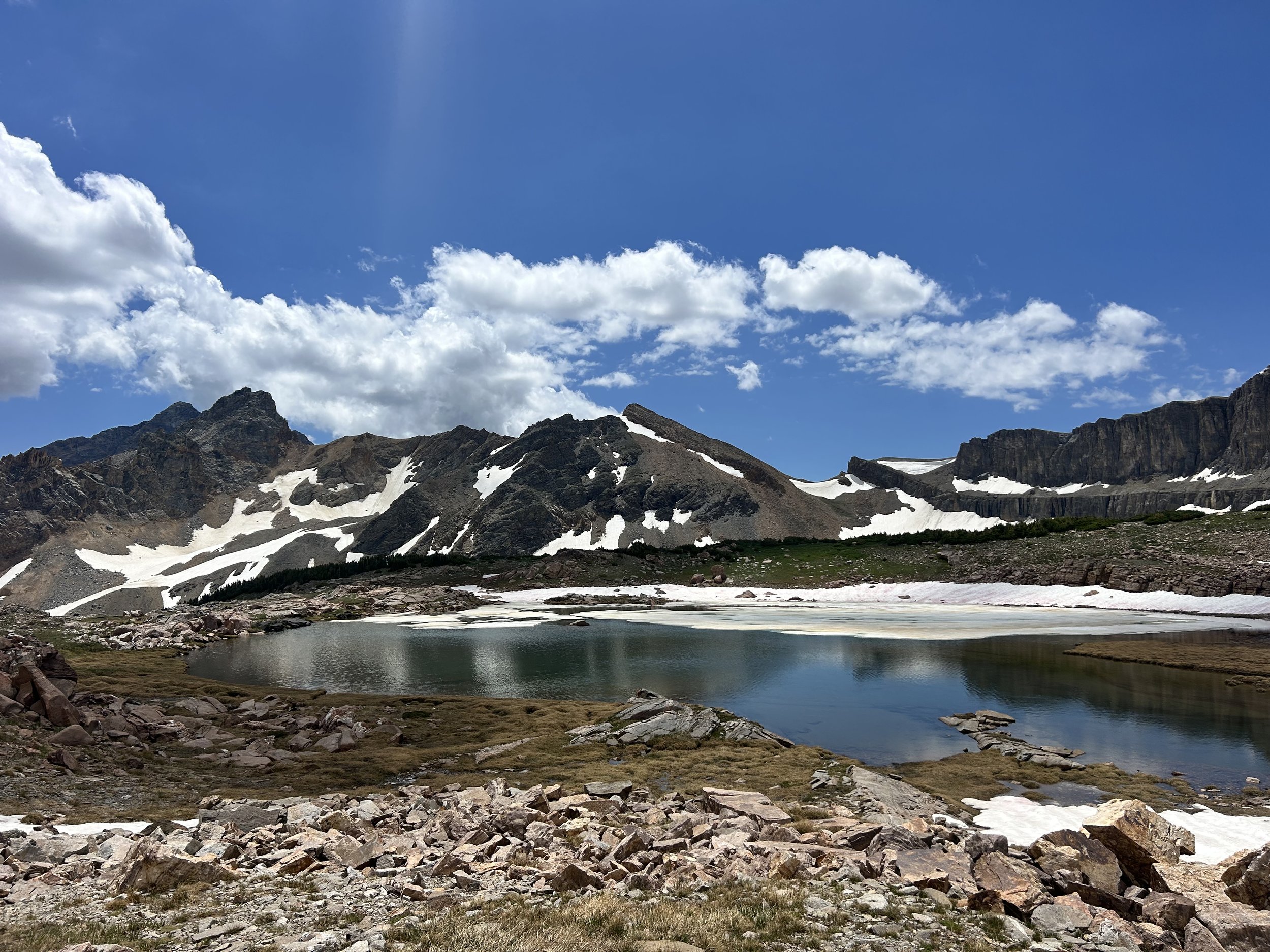
Image from a 20-mile Ken-inspired bushwacking adventure last summer; by some wild coincidence, I ran into Ken and Erika at the very end of this canyon, after passing the whole day without seeing a semblance of a trail or a person
So much time in wilderness grants you an intuition by which to move through the world. Its a feeling in the gut, to the right of the heart and just above the stomach; when the river runs and the fireweed cast out a sweet smell and the pine trees stretch, everything falls together as it should.
Out from the mountains, in Teton Valley, in the belly of the horizon, there’s you loose that lovely, wild feeling. Some time ago — though not too long ago — a man wrote a guide to this part of Idaho:
“These areas, also, once bedded with sagebrush and greasewood, wild grasses, and wild flowers, were regarded as worthless; and less than twenty-five years ago a man was thought to be out of his wits when he went experimentally to one of these arid hills to plant wheat and learn if it would grow. Now nearly every available acre has been plowed; and farms here, as in eastern Oregon and elsewhere, literally hang from mountainsides like pictures, green in June and golden in August. Seen from above, these rolling hills and these less precipitous mountain backbones are alive with tractors that look like huge insects turning the furrows or dragging the harvesters; and in August and September the highways show caravans of trucks hauling the grain. The two forks of Snake River come down out of subalpine valleys and pour their waters through headgates and into canals ; and the whole view, when seen from far up, is one of shimmering lines of silver in the valley and shimmering fields of gold upon the hills (Idaho, a guide in word and picture).”
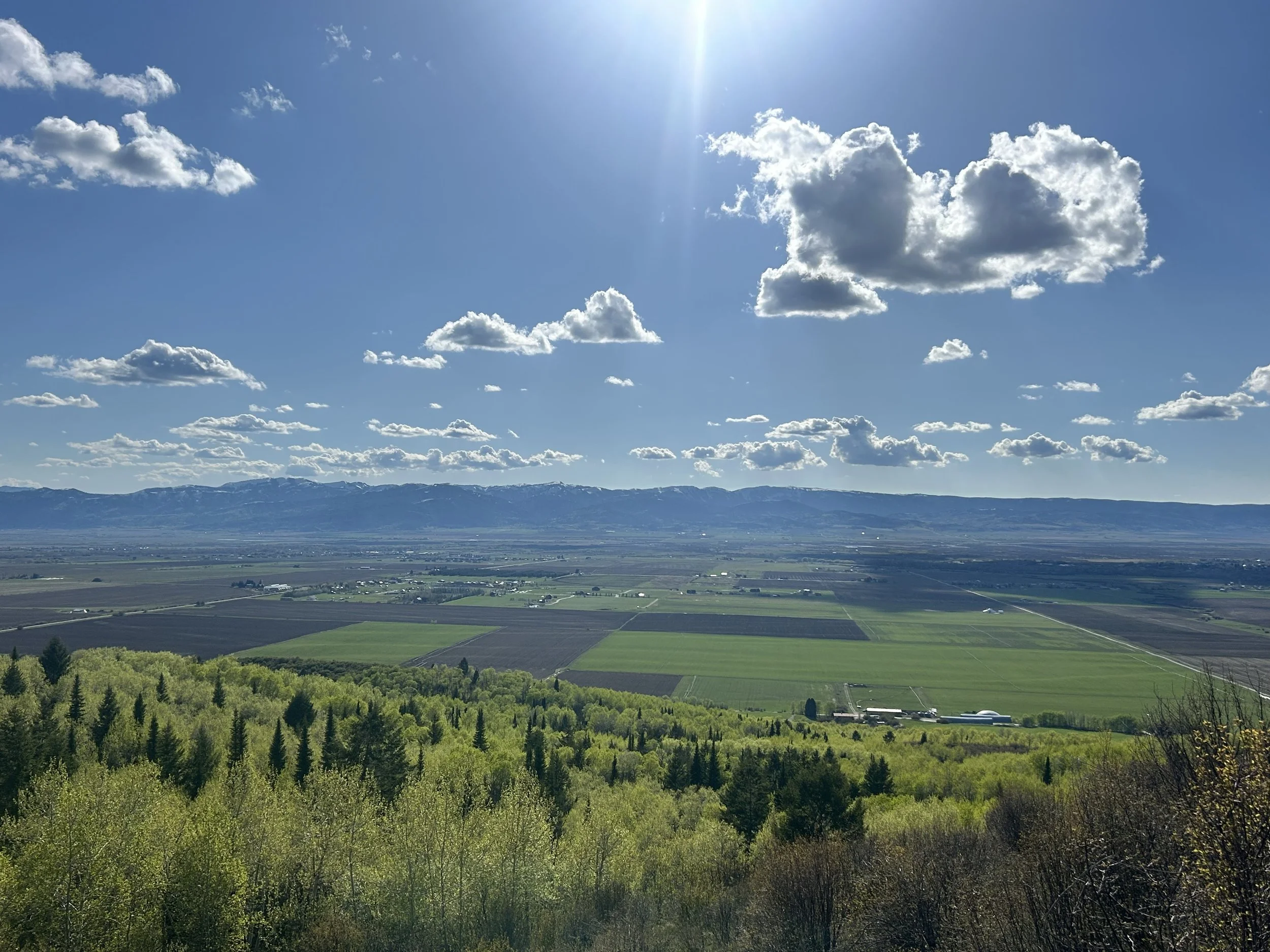
Teton Valley seen from above
The cup of mountains encircling the valley was a great gift in irrigation; every few miles, another canyon, down which surged a great river, spilled water out into the dry grassland all summer, fed by the nearly 500 inches of snow that fell each winter and melted each May. The mormons who first settled Teton Valley in the early 1920s did what they did best, across much of the West; built a church, irrigation canal, and road every mile, slicing the great, flat, wild prairie into a mile by mile grid which turned a heavy brown in May and burned green by July. Traveling west from Teton Valley, towards California, Washington, and Oregon, there stands nothing but well-irrigated monocultures: alfalfa, potatoes, peas, and even the stately figures of christmas trees. Where Full Circle Farm is now, was once a hay pasture, over which, each morning, gulped down gallon after gallon of snowmelt.
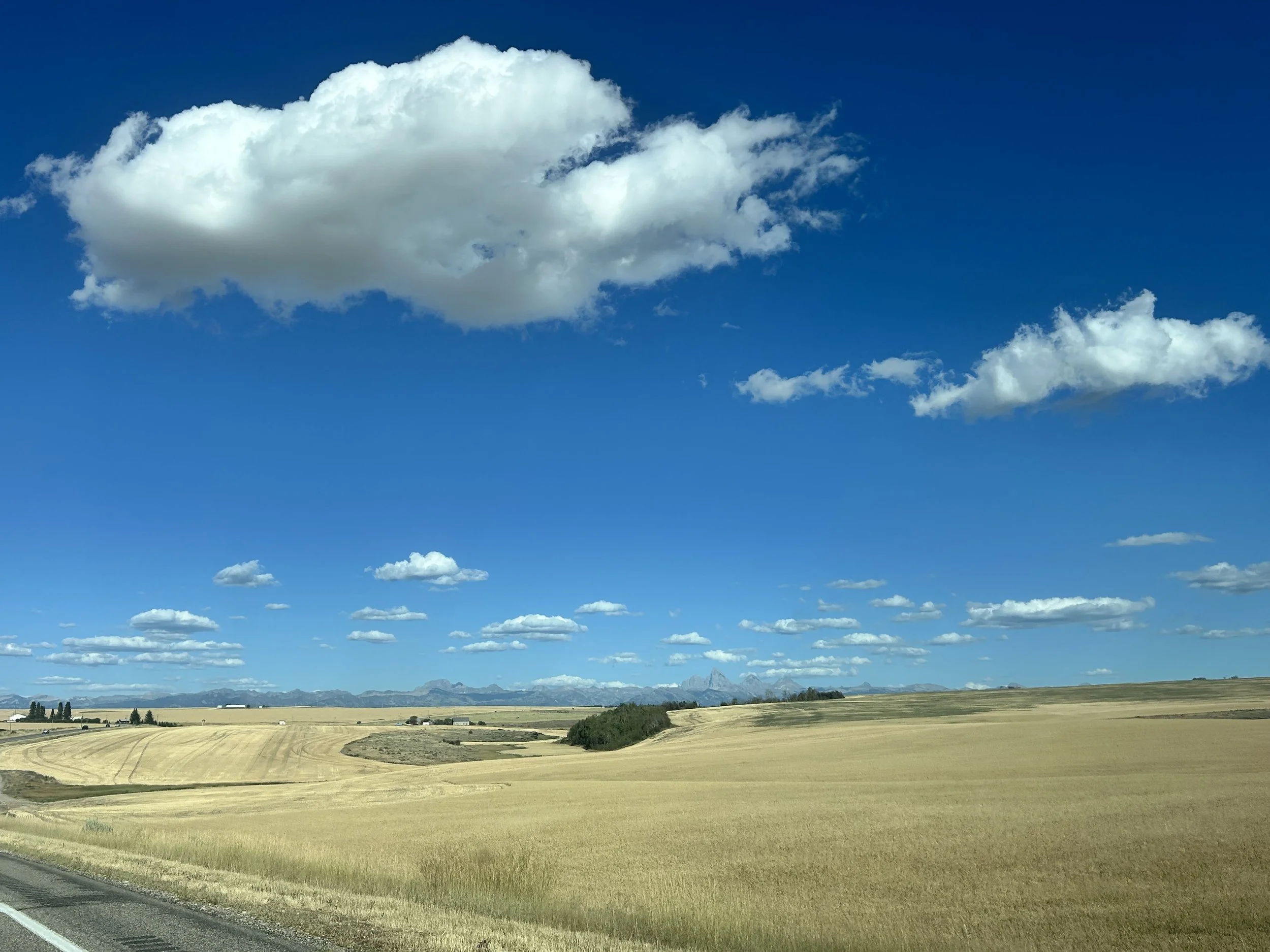
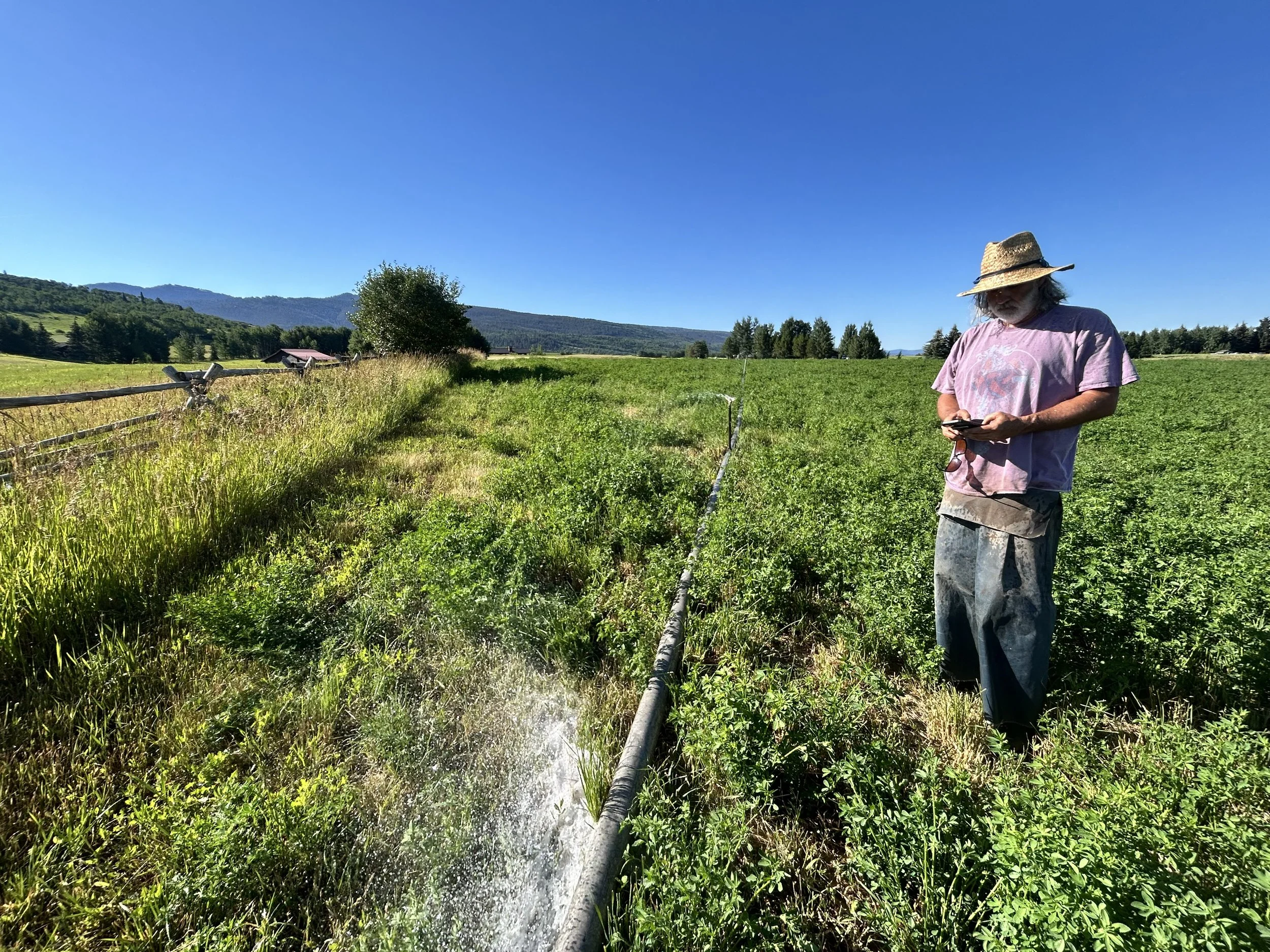
My dad an I moving irrigation pipe over an alfalfa field for our ranching neighbor, Jim Wilson — the Wilsons were one of the first families to farm Teton Valley
Much has happened to America since the 1920s, when the valley saw it’s first canals laid. In 1920, the sweet snowpack, which fed the small farms of Teton Valley, was 20-40% deeper than it is today. Where, according to the US census in 1920, there were once 10 million settlers across the American West, there is now nearly 80 million, stretching out from urban centers and leaching into landscapes where there once were farms; and where there is farmland, there are monocultures, chasing the banks of waterways like the Snake River from their headwaters in the Tetons to the estuaries of the Pacific.
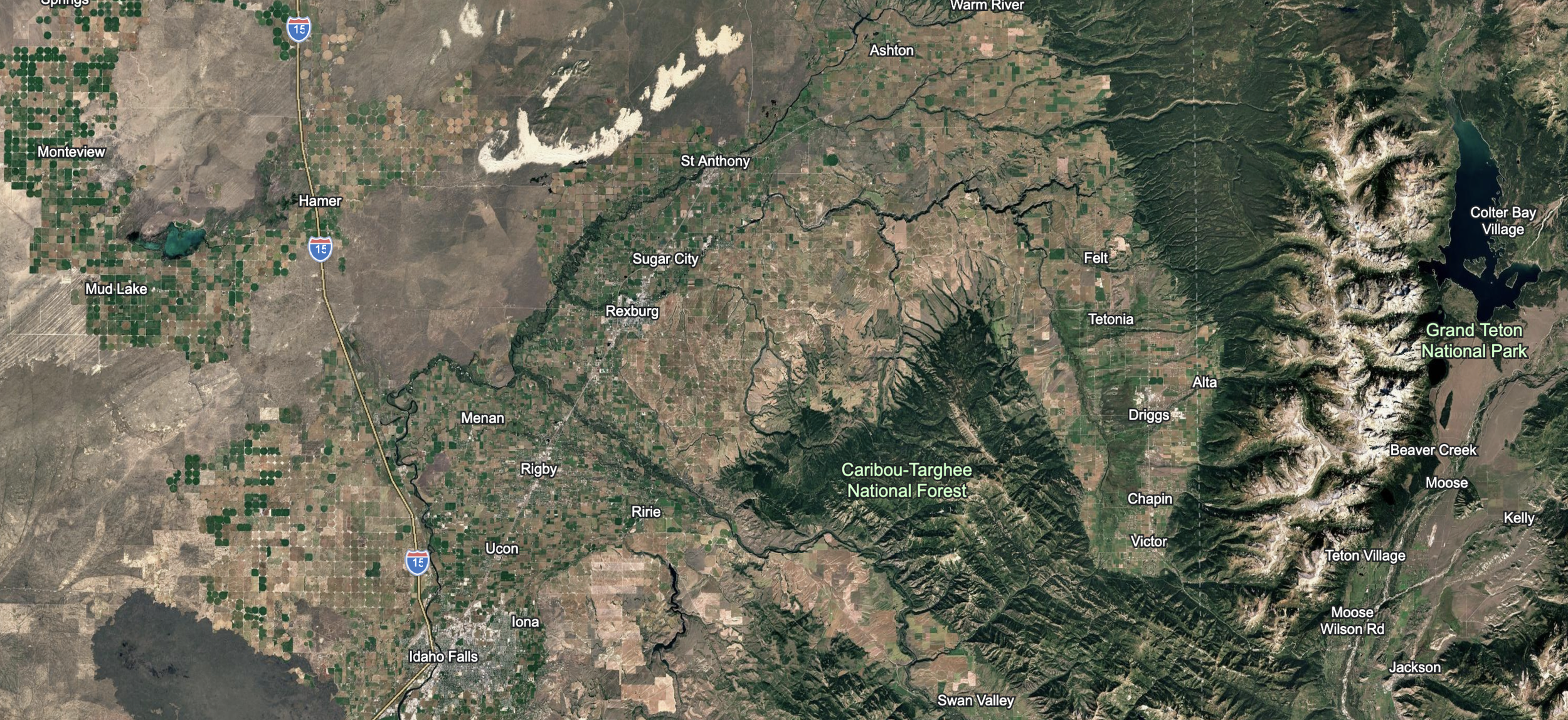
Farms chasing water out from Teton valley; to the far right, Driggs, Alta and Chapin, where Full Circle Farm is located.
I wonder what Malthus and Steiner would see in the modern American West. I imagine they would see a population at the utter brink; they would see a land and soil stretched so thin, used so heavily under the hands of tractors and combines, that the end of days must be resting in the shadows of each horizon. Malthus’s great prophecy of American expansion and declining farmland had come true.
As the story of Full Circle Farm goes, the land was listed for a housing development. Far too expensive for a farmer’s budget, Ken and Erika were able to leverage an agricultural easement from te local land trust to lower the price of the land, and applied for a couple government loans to cover the remaining cost of the property. To them, Full Circle Farm would be a chance to protect and give back the land to the birds and the hills above; farming was a project of restoration. As they say: On this farm, we build soil.
A healthier soil means less water use; means a farm more resilient to the ongoing transformations affecting farmlands across the West.
The Cosmos
We gather at the leaning picnic table, beside the high tunnel, behind the line of aspens. Before us, to the west, the valley yawns and stretches towards the horizon. Snowfields high in the Big Hole mountain range glint in the rising sun. The supple silhouettes of swallows duck in and out of the wide, blue sky. The grass rubs against our ankles. We lower our heads and sit quietly for a minute or two. Ken says he can tell when the meditation is over by the swelling feeling in his chest — by the end of the summer, I start to feel it too.
The meditation is meant to tether us to the farm at the start of each day. We realign, fall back in rhythm with the early-morning scent of wet dirt, the sound of sprinklers, birdsong. From there, our work days on Full Circle Farms are directed by the moon. Rather, they are directed by Maria Thun’s Biodynamic Calendar — which categorizes each day into root, leaf, fruit, or flower, informed by the thrust of the cosmos. On cold, dry, root days, we weed carrots, harvest radishes, mound the potatoes, and plant beets. On rainy leaf days, we tend to lettuce and herb crops; on sunny fruit days, we stay in the high tunnels enveloped by tomato crops, or lay tarp on the squash; on cool, sunny flower days, we hang chamomile and arrange ornate bouquets of Dahlias and larkspur.
The theory is, the organism of the farm cycles in turn with the cosmos. At each part of the cycle, it tends to a different part of its organization — on root days, the moon is in a “descending” phase, thus pulling water and nutrients into the dirt.
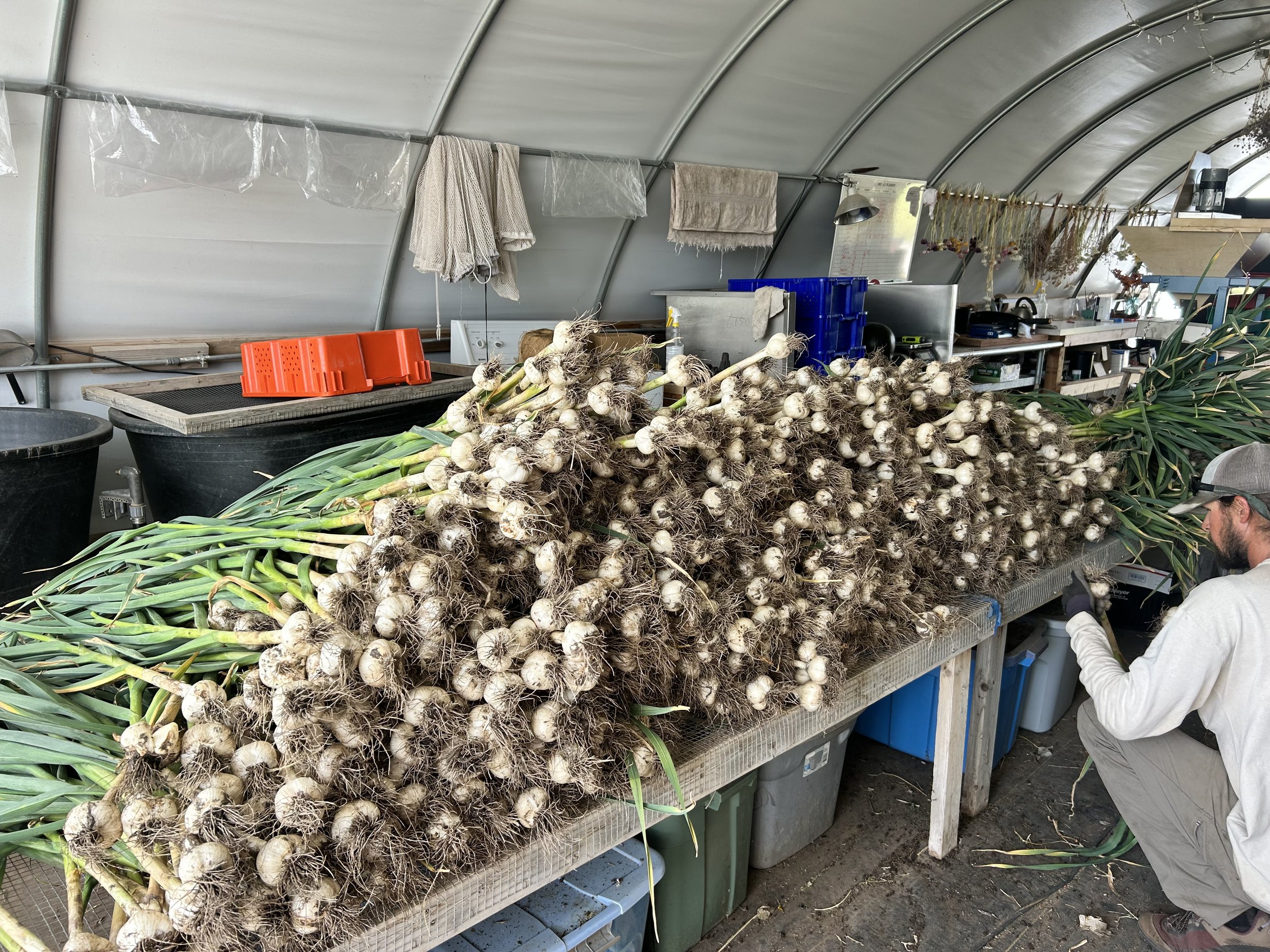
Garlic harvest from a root day
Steiner believed the first farmers were inherently attuned to this cycle; that they knew, by the weather and the feel of their crops, when it was best to tend to roots or harvest fruit. Since the demands of industrial agriculture threw this attunement askew — fertilizers inhibited the natural growth of plants, and the demands of large-scale monocultures inhibited the patience and diversity needed for this cycle. Author of the biodynamic calendar, Maria Thun, formalized this cycle through 50 years of experiments on radish plants. Tended to on descending moon days, the radishes thrived; tended to on none moon-days, they split, turned mealy, or too bitter.
The Preparations
Full Circle Farms stretches 20 acres, including a hay field, a cow pasture, four high tunnels, and about two dozen crop beds. On these 20 acres, at the opening of each season, they spread Steiner's biodynamic preparations.
Stuff a horn with manure and dried herbs, and bury it deep beneath the earth for a winter to “enhance the life of the soil”; fill a deer bladder with yarrow to accelerate the breakdown of organic matter; pound nettle in a clay pot to improve disease resistance. There are 9 official biodynamic preparations — each meant to support a specific aspect of soil health, just as a herbal supplement would support human health. Ken and Erika opt for a prep made from the shed horn of one of their cows, manure, dried chamomile, and the leftovers of last year’s medicinal herb harvest. They add the prep to a barrel of water, which is then poured into buckets. We spent days walking from one corner of the farm to another, dipping the broken ends of brooms into the prep, and rubbing our hands along the bristles to send the prep spraying across the soil. The remaining prep is added to the farm’s compost. The farm’s biodynamic “fertilizer” is recycled from the farm itself; last season’s excess is pulled into this season; it is a form of digestion, stuffed into the belly of the soil, recollected in the spring to power the next crop.
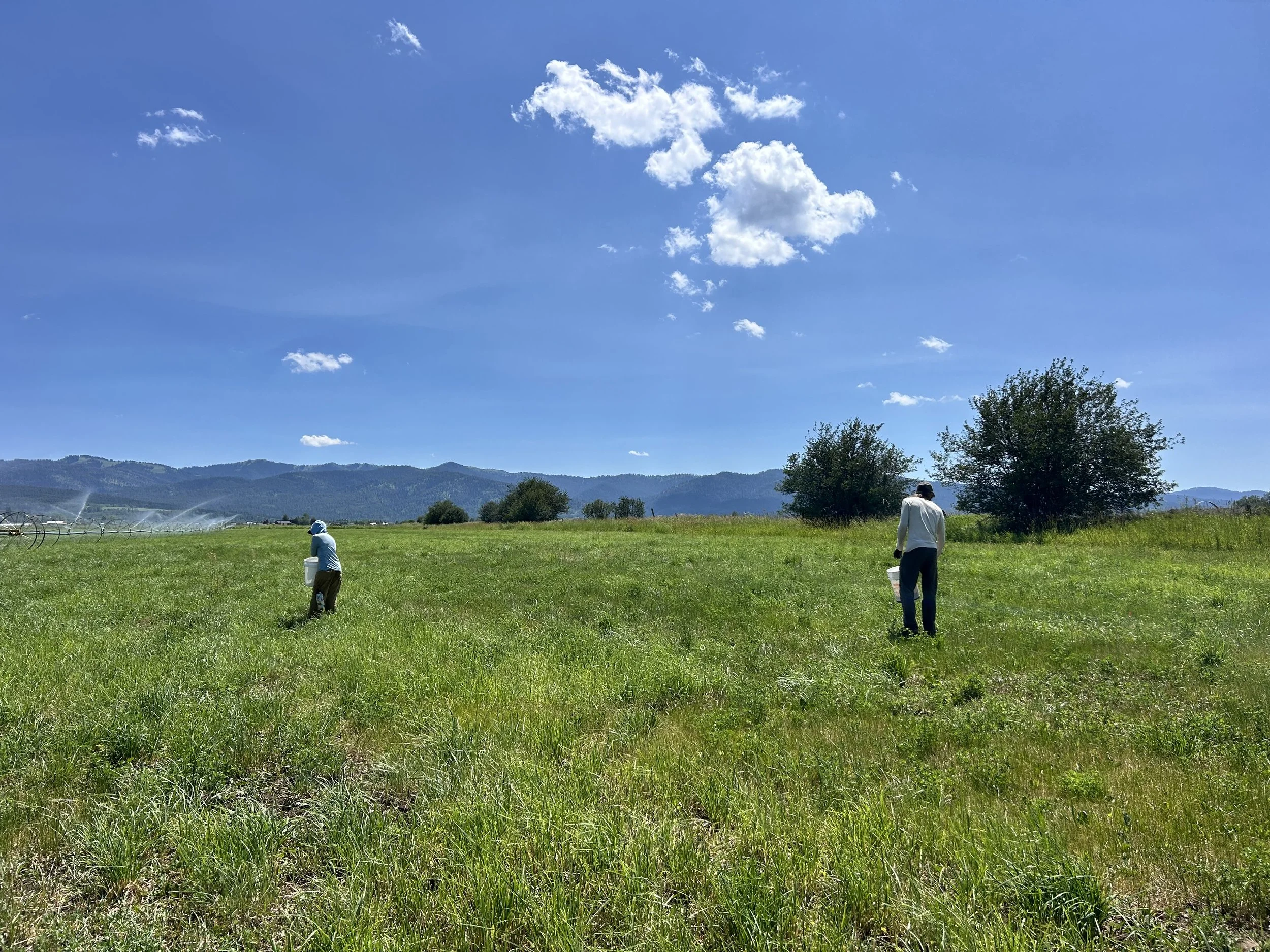
Spraying prep
Ken speaks tenderly of his soil. It’s like a city, he says; by disrupting it, churning it, plowing it, entire apartment buildings collapse. This would be bombing a city, he says. So instead, treat it gently — feed it, nurture it, let it be. Trust that with the right care, it will do exactly what it must. The Gnomes will tend to it — the cosmos will return each element to equilibrium.
Ken says that humans were evolved to farm. That it’s our niche — just as bees pollinate flowers or mice eat the tops of radish. So he spreads the prep, pulls the weeds, does what he must do to guide the farm organism.