Parting words of gratitude from Mark Bomford, YSFP Director 2011-2026.

The grassy hill serves as nifty proscenium (not pictured, at right: eighty architecture students in a discussion on land, care, and control). Photo by Jacquie Munno.
Monday, June 29, 2026
Dear friends,
As this is my final newsletter as director, I want to begin where this work always begins: with gratitude. For fifteen years it has been my privilege to help steward the Yale Sustainable Food Program, and as this chapter comes to a close, what’s foremost in my mind is less a list of accomplishments than it is the faces of the people who made them possible. I think of students who arrived early and stayed late, who kept showing up morning after morning and year after year, through glorious spring sunrises and crisp fall sunsets, through summer humidity and downpours, digging out from hoophouse-crushing snows and battening down for the occasional nor’easter, gathering around the great oak table beneath the Lazarus Pavilion, where the oven’s hearth was always warm and the welcome always open. I think of the generous farmers and cooks and community leaders; the faculty who saw in an acre of New Haven soil a classroom unlike any other; the alumni who carried this place into the world; and the donors, colleagues, and staff whose thoughtful, sustained care held it together, season after season. The list of those I should thank would stretch into the thousands.
For fifteen years the program was many things at once. It was a farm, a classroom, a convening space, and a stage for moments I could not have imagined when I first arrived. It became a place serious enough that people who helped shape the modern food movement came to walk its fields and share its tables, among them Leah Penniman, Wendell Berry, Bryant Terry, Wes Jackson, Jeanette Armstrong, Bill McKibben, Michael Twitty, Michael Pollan, Olivier De Schutter, then UN Special Rapporteur on the right to food, and Alice Waters, herself a Yale honorary degree recipient. (Not every memorable guest came as a figure in the food movement — Stephen Colbert’s visit to the farm was a particular delight.) And the YSFP was taken seriously in return: in policy, through a roundtable with Tom Vilsack, then U.S. Secretary of Agriculture, and our presentations to the UN Food Systems Symposium; in civil society, through the international organic and agrarian movements and the food-sovereignty dialogues that gathered farmers and scholars from many countries; in technology, as a collaborator with the Google Food Lab in the heart of Silicon Valley; in food innovation, through our work with the Nordic Food Lab; and in questions of faith and ethics, when an invitation through the Notre Dame School of Architecture asked us to reassess Pope Francis’s farm at Castel Gandolfo in the wake of Laudato Si’. Students carried the questions of food, agriculture, ecology, and justice from New Haven around the world, conducting original research in more than twenty-five countries, from Guatemala and Peru to Bhutan, Sri Lanka, Ghana, and the Arctic communities of Canada. These were formative research experiences that yielded senior theses, published work, and lasting partnerships abroad, and that helped students understand food systems as lived, governed, and contested in place.
I came to this work first as a farmer and natural scientist. At the University of British Columbia, where I had founded the Centre for Sustainable Food Systems, I learned to read agriculture through instruments and field practice — the eddy covariance tower and the mass spectrometer, the soil pit and the forest transect, the patient habits of ecological observation, measurement, and interpretation. That training remains precious to me, and the natural sciences remain indispensable to any careful account of food and farming. When Peter Salovey, then Provost and soon to be President, invited me to continue and grow that work at Yale, I found something wonderfully stranger than I had expected and, in the end, far more generative. There was no conventional Department of Agricultural Sciences at Yale, and what first felt like an absence became an intellectual liberation.
Freed from a single disciplinary home and vivified through Yale’s commitment to the liberal arts, the YSFP became a place where food and agriculture could be understood at once through the natural and social sciences, the humanities and the arts, and through history, politics, culture, economics, justice, and imagination. The Program in Agrarian Studies offered a formative opening, a standing invitation to partner in exploring food and farming across many disciplines and to find in those perspectives more hopeful political possibilities than any single discipline could hold. Research collaborations took root in that soil, encouraged in those years by Dean Marvin Chun, to whom I remain very grateful. Over time I came to believe that Yale’s greatest contributions to sustainable food and agriculture lie less in the carefully bounded science the land-grant universities already do so well than in the synthesis that conventional disciplinary frames so often make difficult or impossible. Slowly this reshaped what I understood food literacy to mean. It became less the reading and consuming of knowledge and more a matter of collaboration and co-production, of helping to write the worlds we inhabit as active participants rather than only studying them as imagined neutral observers.
The deepest rewards, however, came through teaching. For eleven years I had the privilege of teaching a perennially oversubscribed Yale College seminar, every year reaffirming the hunger for learning that was serious, materially grounded, and open to uncertainty. The teaching grew far beyond one seminar. Over the years the farm drew classes from more than thirty departments and eight professional schools, well over a hundred faculty colleagues, and roughly a thousand students annually in credit-bearing work and several thousand farm visits in all. The disciplinary breadth was, I think it is fair to say, second to none.
Some of that teaching was unlike anything happening elsewhere, and some of it, I suspect, had never been attempted anywhere before. With MFA students from the School of Art, we asked how sustainability is learned aesthetically; what forms of beauty train us toward control, and what forms toward humility. Through wheat, we asked how a single staple gathers labor, land, capital, and daily bread into one plant. Through dye plants, we followed color back into soil, season, craft, and culture — even to the imperial calico trade whose threads run back to Elihu Yale himself. And through the Three Sisters of corn, beans, and squash, grown with the Native American Cultural Center and an Abenaki seed keeper we worked alongside for many years, we taught agriculture as relation rather than input-output management, with ecology, history, and Indigenous knowledge as living pedagogy rather than museum exhibit. The farm brought these questions to life. To learn there is to be present with one’s whole self, to think with the body, to discover that attention itself is a discipline. A bed has to be weeded, a crop harvested, a storm is coming, a student asks a question that changes the direction of the day.
Some of the program’s most lasting learning ran the other way, from others toward us. The farm became a place where Indigenous food sovereignty could be practiced, and student seed keepers carried seeds to and from tribal communities across the Northeast. New Haven itself offered teachers of every kind, a city rich in urban agriculture and land-based education, in long-standing mutual aid networks and powerful solidarities. Our neighbors were always a source of inspiration, and we worked to respectfully reciprocate, whether by sending students to help organize the city’s food-policy work, hosting visiting thinkers at public libraries and neighborhood churches, or offering hands wherever they were needed. If the farm did one thing well, it was to stay open and welcoming to all.
This spring, many former students, colleagues, and neighbors gathered under the Lazarus Pavilion to mark this chapter, and hearing what they shared was among the great gifts of my time here. Eli White ’25 generously observed, “I ended up being more a student of this farm than a student of Yale — and to be a student of this farm, to be a student of Mark’s, is a rare and wonderful gift. No other place on campus let me hold the questions or the truths I wanted to hold quite like this place.” Those words, and many others offered that afternoon, are gathered here. They reminded me that the most durable harvest of this work has always been people. Those memories will stay with me, and animate my work, wherever I go.
The farm teaches something hard to name, and perhaps more needed now than ever. In a classroom it can still be possible to imagine learning as the orderly acquisition of knowledge, clearly signposted through accumulating credentials. On a farm that illusion does not last long. Shared participation becomes unavoidable, the work urgent, the conditions never fully knowable. Weather changes. Bodies tire. Seeds fail. Tools break. Weeds return. Plans meet the world. The lesson is humility rather than paralysis. Even as the imperative to act remains, we must proceed without omniscience and without omnipotence, never holding all the information or full control, and still there is work to do.
That is the clearest expression I have of what this work has tried to teach, and it is also the rarely written and frequently discussed motto of the YSFP: cultivate radical humility. Cultivation, the intervention that spins up the flywheel of a growing season, holds both senses of its root cultus. It is the careful act of making a space sacred, nurturing the mind, or growing a culture, and, conversely, it is the pretext to colonize, often pursued with cult-ish monomania. Humility shares its root with humus, that strange, generative soil fraction so hard to tell as living or dead, or to say where it begins and ends. It shares a root, too, with human, and even with hubris. To be humble, in the oldest sense, is to remember that we come from the soil and return to it. Radical means, quite literally, of the root, from radix, a reminder to dig past the surface of our food-and-climate problems to their entangled roots in history, materiality, politics, and place. Humility of this kind is not meekness, and it is not deference. It is not the quiet surrender of those who decide they cannot know enough to act. It is, rather, a serious intellectual, ecological, and civic practice. It is the discipline of attention, of recognizing interdependence rather than denying it, of caring for a place without presuming to command it, and, knowing how bound we are to the soil and to one another, of fighting for the places and people we love. In a future of ecological uncertainty, when institutions too often seem unable to respond with creativity and courage, these are not ornamental skills. They are the ones our students will need most, and they carry them into policy and finance, media and the arts, the sciences and the land itself. They carry the farm with them. They always have.
A program is only ever borrowed from the future. The seeds planted at the Yale Farm nearly twenty-five years ago were planted by people who trusted that others would tend them, and the ones we have planted since are full of a latent and enduring hope. As long-time friend of the farm Professor Jim Scott was fond of saying in one of his frequently wise moments, only dead fish swim with the current. The YSFP is not dead, and neither is its impulse to swim against complacency, against resignation, against convention that would rather not be questioned. I have tried to be a good steward of the trust I inherited, and I leave knowing that the work itself — the soil, the tables, the relationships, the habit of radical humility — belongs to no one person and outlasts us all. My deepest thanks to everyone who has been part of it. It has been the honor of my working life.
With gratitude,
Mark Bomford
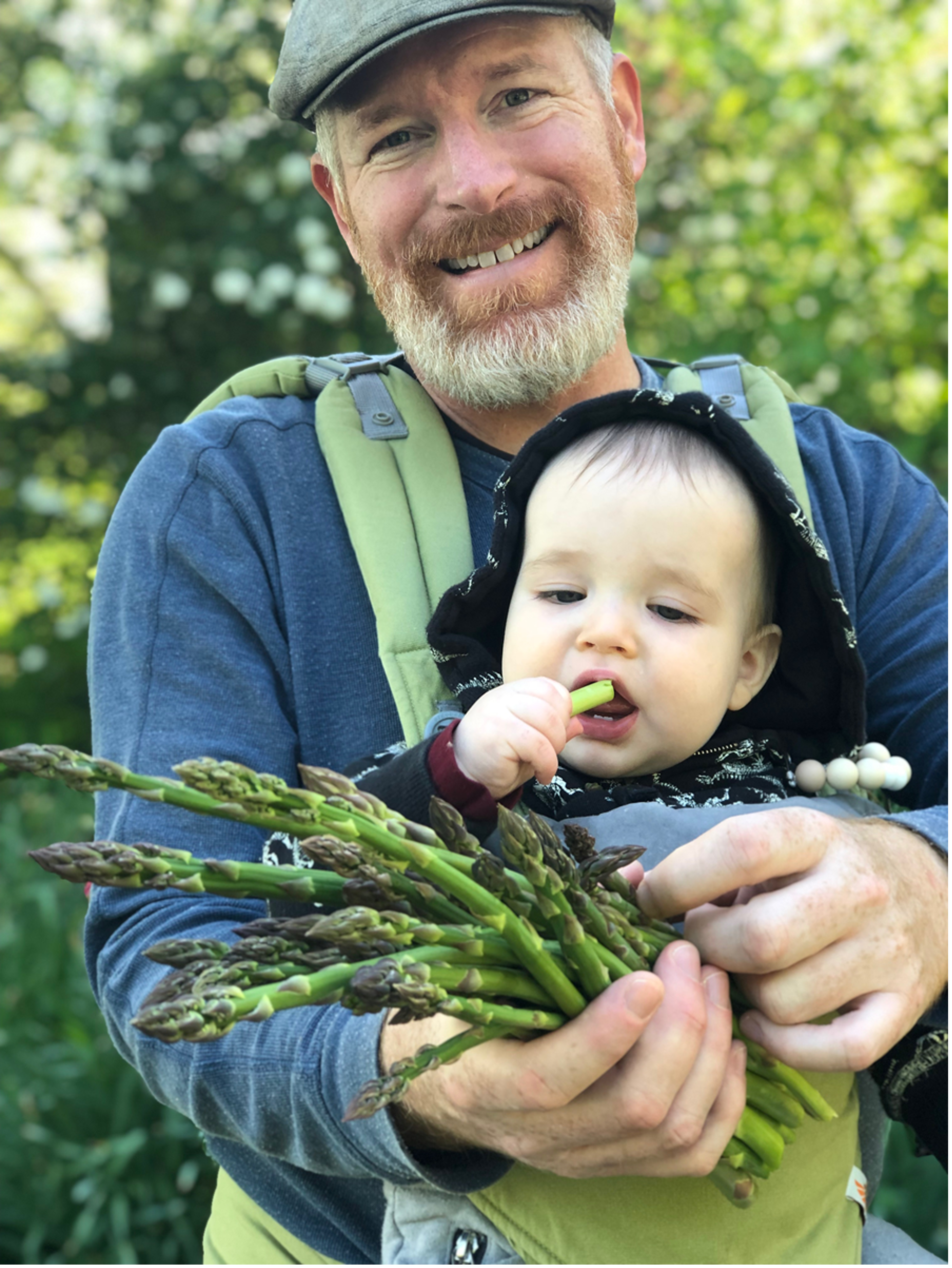
Cultivating Radical Humility and Asparagus. Photo credit: Samara Brock
Reflections
On the afternoon of April 30 2026, students, alumni, faculty, staff, and friends gathered at the Yale Farm to celebrate “Mark Bomford and his visionary leadership in food and agriculture at Yale and beyond.” Guests shared written and spoken words of appreciation, a selection of which are shared with permission below. A more complete record may be found here.
In a lot of ways I ended up being more a student of this farm than a student of Yale. And to be a student of this farm, to be a student of Mark’s, is a really rare and wonderful gift. No other place on campus let me hold the questions or the truths I wanted to hold quite like this place. I wrestled with those questions in the kneading of dough, and tended those truths in the weeding of carrots. Mark’s leadership as a director created the capaciousness of the space to hold all of that, to hold all of us. This program let me be physically present with what I really cared about — feeding people — at a time when I didn’t really know what I cared about. Mark’s class was my introduction into taking those questions seriously, and it was also the first class at Yale I actually felt at home in. That was the first moment at Yale where I felt like where I had come from and where I was sitting actually connected, where I was who I actually was and wasn’t trying to be someone else. Mark invites students into taking seriously what we’re already doing, what we’re already thinking about, what we might overlook as important — or what Yale might encourage us to overlook as important.
— Eli White, ’25
Mark is incredibly humble. He is someone I have observed, time and again, even in all his brilliance, demonstrate a willingness to learn, to lead adaptively, to pivot, and to listen. He has taught me that intelligence is less about knowing everything — even if he does — and more about knowing what questions to ask. And despite his authoritative title as director, above all the constituencies he has had to manage, his profound commitment to students has always been the priority. Mark takes people seriously, even when they don’t take themselves as such. Both my senior essay and my master’s thesis had their origins in kind of throwaway comments and emails I had sent to Mark, which he then validated and offered more insight of his own into. I’d be doing a bad job as a forever-ambassador of the YSFP if I didn’t mention that the root word for humility is shared with the Latin humus, meaning soil.
— Austin Bryniarski, alumnus and former Lazarus Fellow
When I first arrived at the YSFP, I thought I knew what sustainable food was. I thought I had the answer — and then came you, Mark, who, in the most amazing and energizing way, made it clear that I didn’t: that the work is not about having the answer, but about learning how to live in the questions, to stay in the mess and the gray areas, to resist the urge to simplify what is in fact deeply complex. You invited me to become a lifelong learner. It’s so much more fun than knowing the answers, and so much more rewarding. You modeled what generous leadership can look like. You built a program, yes, but more than that you shaped a way of being in this work — one that is generous, rigorous, imaginative, and deeply human. Under your leadership, the Farm became a place people wanted to be, not because it made them feel exceptional, but because through stewardship they came to understand that they matter.
— Jacquie Munno, YSFP Programs Manager
Mark Bomford embodies the liberal-arts project in himself, in the most human way possible. He has an improbable, almost confusing amount of expertise across every topic, and he asks us — insists that we — actively, tirelessly keep seeking out the interconnectedness of seemingly unrelated phenomena. With Mark, everybody here, and so many people who couldn’t make it today, knows that when you pull the thread you get the tapestry. It felt as though a menu of every discipline in the liberal arts lay open before us, each one a way to ask what a campus farm could make possible that isn’t here yet. Fourteen years later, we’re still exploring that, and we haven’t stopped for a day.
— Jeremy Oldfield, YSFP Farm Manager
I quickly came to see why the farm exists so miraculously and unexpectedly at Yale. Of course its genealogy is older than Mark, but its form and function today are the product of his visionary leadership and his insistence on the importance and urgency of food education. This program has produced generations of thinkers committed to climate justice and food justice, to Indigenous rights, to community building, to deliciousness and nourishment for everyone — not just the privileged few. These are our pathways toward the otherwise-future that so many of us under this pavilion dream of.
— Hiʻilei Hobart, Professor of Native and Indigenous Studies
I have learned so much from Mark — about everything from Marxist political ecology to indoor agriculture to the history of the land we’re standing on. These students who say he is the most brilliant mind on this campus: I see where they’re coming from. So thank you, Mark, for all that you’ve taught me, year after year, class after class.
— Deb Coen, Professor of History; Chair, Certificate in Food, Agriculture and Climate Change Faculty Advisory Committee
We know that food plays a part in every aspect of life — agriculture, science, politics, economics, environment, art, and literature. Under Mark’s visionary leadership, multiplied by the talents and dedication of Jacquie and Jeremy, the YSFP moved from being a project to a Program with a capital P, addressing all of those areas and integrated into a range of academic programs across the campus. The establishment of the certificate in Food, Agriculture, and Climate Change is the crowning achievement of those efforts — a tribute to Mark’s dedication, inspiration, innovation, and perseverance.
— Dennis Danaher, former Senior Associate Director, Major Gifts, Yale University Office of Development and Alumni Affairs
The YSFP would say, ‘Hey, can our students help? Would you like students to take notes at the food summit for the City of New Haven as they’re trying to pass a food policy? We have famous, inspiring food people coming to New Haven — would you like them to do an event? They’ll be here two days; we’re only working with them on Friday. Would you like them to come on Thursday and do an event at the New Haven Public Library or a local church?’ What this place exemplifies is how an institution at Yale can be in reciprocal relationship with the people of New Haven — not isolationist, not selfish, but actually sharing resources. That’s the lesson of plants and nature: reciprocity. This is one of the few places at Yale where I have experienced this.
— Tagan Engel, lecturer, Yale School of the Environment
The YSFP, this little one acre — it came to be, and it’s so beautiful, because of all of us, because of the momentum we’ve created, and because of the good words we’ve put into the ground: the good words that Mark Bomford has given to all of us, that we’ve ruminated on, and that have grown inside of us. … We’ve grown medicine in this place that grows nowhere else on Yale’s campus, and we can give that back now to our community. I’ve been honored and grateful, in my position as seed keeper, to travel and visit with tribal communities around Connecticut and the Northeast — to share the seeds we’ve been gifted, and also to receive seeds and plant them here, to plant the stories of those people here in this place. That is so powerful. … Mark helped to bring out a lot of the language and words for things that I already knew and had been feeling, and I think that’s the case for a lot of Indigenous students on campus. We know what these connections feel like in our bodies, we know what it looks like to be in good relation, but we don’t always know how to enact that with our non-native relatives and with those in diaspora — and this is a really special and beautiful place where that happens. Thank you, Mark, and thank you to this incredible team you’ve brought together, for the opportunity to share such a sacred place.
— Ivy Pete ’26 YSFP seed keeper