Cultivate Radical Humility
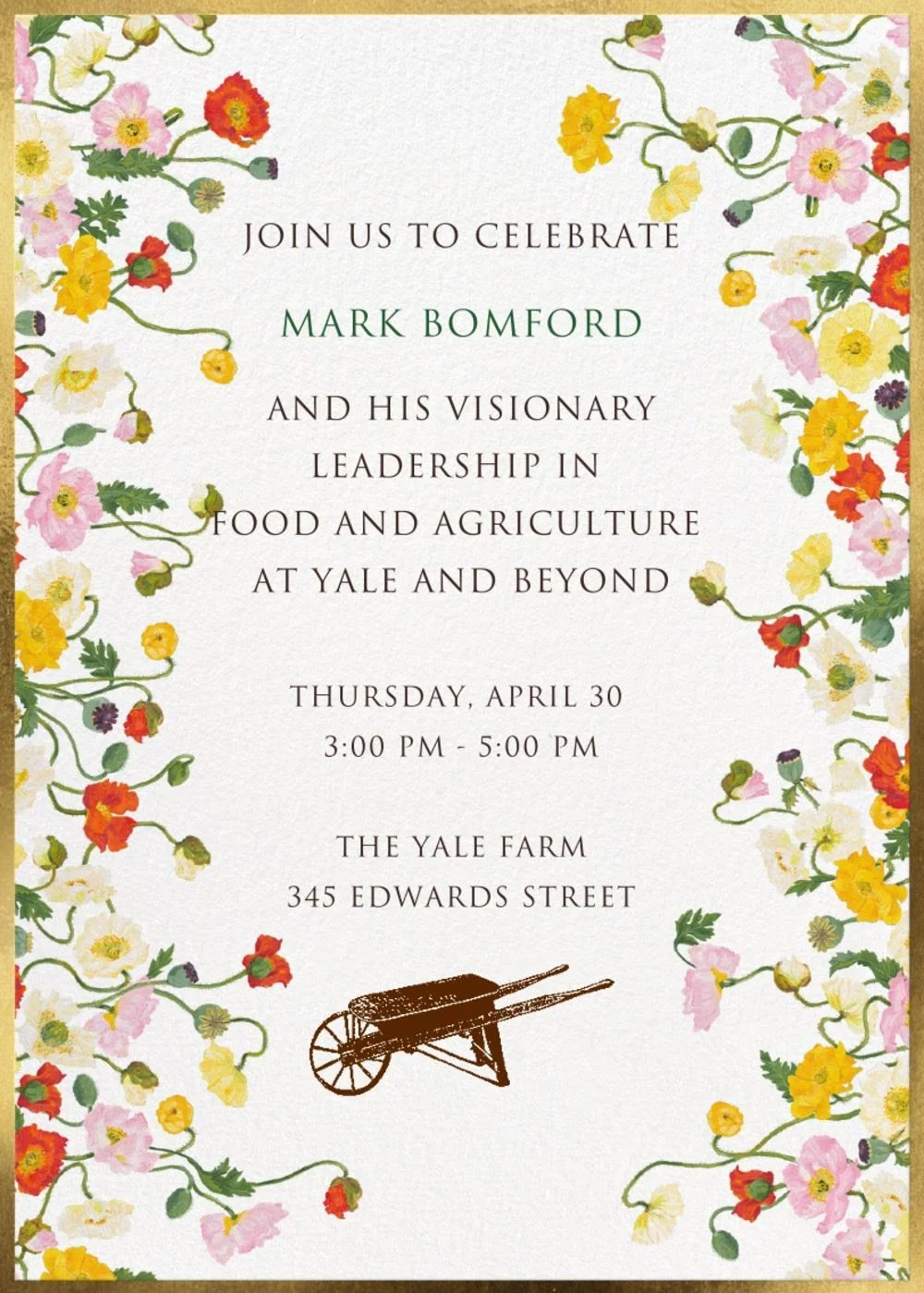
A gathering to celebrate Mark Bomford and his visionary leadership in food and agriculture at Yale and beyond. The Yale Farm, Thursday, April 30, 2026
On the afternoon of April 30, 2026, students, alumni, faculty, staff, and friends gathered at the Yale Farm to celebrate Mark Bomford and his visionary leadership in food and agriculture at Yale and beyond. A selection of the words shared that day, and in messages since, is gathered here, posted with each contributor’s permission, and added to as more arrive.
Spoken at the gathering
Remarks delivered in person at the celebration under the Lazarus Pavilion on April 30, 2026.
In a lot of ways I ended up being more a student of this farm than a student of Yale. And to be a student of this farm, to be a student of Mark’s, is a really rare and wonderful gift. No other place on campus let me hold the questions or the truths I wanted to hold quite like this place. I wrestled with those questions in the kneading of dough, and tended those truths in the weeding of carrots. Mark’s leadership as a director created the capaciousness of the space to hold all of that, to hold all of us. This program let me be physically present with what I really cared about — feeding people — at a time when I didn’t really know what I cared about. Mark’s class was my introduction into taking those questions seriously, and it was also the first class at Yale I actually felt at home in. That was the first moment at Yale where I felt like where I had come from and where I was sitting actually connected, where I was who I actually was and wasn’t trying to be someone else. Mark invites students into taking seriously what we’re already doing, what we’re already thinking about, what we might overlook as important — or what Yale might encourage us to overlook as important.
— Eli White, Class of 2025, Food, Agriculture & Climate Change certificate
Mark is incredibly humble. He is someone I have observed, time and again, even in all his brilliance, demonstrate a willingness to learn, to lead adaptively, to pivot, and to listen. He has taught me that intelligence is less about knowing everything — even if he does — and more about knowing what questions to ask. And despite his authoritative title as director, above all the constituencies he has had to manage, his profound commitment to students has always been the priority. Mark takes people seriously, even when they don’t take themselves as such. Both my senior essay and my master’s thesis had their origins in kind of throwaway comments and emails I had sent to Mark, which he then validated and offered more insight of his own into. I’d be doing a bad job as a forever-ambassador of the YSFP if I didn’t mention that the root word for humility is shared with the Latin humus, meaning soil.
— Austin Bryniarski, alumnus and former Lazarus Fellow
When I first arrived at the YSFP, I thought I knew what sustainable food was. I thought I had the answer — and then came you, Mark, who, in the most amazing and energizing way, made it clear that I didn’t: that the work is not about having the answer, but about learning how to live in the questions, to stay in the mess and the gray areas, to resist the urge to simplify what is in fact deeply complex. You invited me to become a lifelong learner. It’s so much more fun than knowing the answers, and so much more rewarding. You modeled what generous leadership can look like. You built a program, yes, but more than that you shaped a way of being in this work — one that is generous, rigorous, imaginative, and deeply human. Under your leadership, the Farm became a place people wanted to be, not because it made them feel exceptional, but because through stewardship they came to understand that they matter.
— Jacquie Munno, YSFP Programs Manager
The YSFP would say, ‘Hey, can our students help? Would you like students to take notes at the food summit for the City of New Haven as they’re trying to pass a food policy? We have famous, inspiring food people coming to New Haven — would you like them to do an event? They’ll be here two days; we’re only working with them on Friday. Would you like them to come on Thursday and do an event at the New Haven Public Library or a local church?’ What this place exemplifies is how an institution at Yale can be in reciprocal relationship with the people of New Haven — not isolationist, not selfish, but actually sharing resources. That’s the lesson of plants and nature: reciprocity. This is one of the few places at Yale where I have experienced this.
— Tagan Engel, lecturer, Yale School of the Environment
The YSFP, this little one acre — it came to be, and it’s so beautiful, because of all of us, because of the momentum we’ve created, and because of the good words we’ve put into the ground: the good words that Mark Bomford has given to all of us, that we’ve ruminated on, and that have grown inside of us. … We’ve grown medicine in this place that grows nowhere else on Yale’s campus, and we can give that back now to our community. I’ve been honored and grateful, in my position as seed keeper, to travel and visit with tribal communities around Connecticut and the Northeast — to share the seeds we’ve been gifted, and also to receive seeds and plant them here, to plant the stories of those people here in this place. That is so powerful. … Mark helped to bring out a lot of the language and words for things that I already knew and had been feeling, and I think that’s the case for a lot of Indigenous students on campus. We know what these connections feel like in our bodies, we know what it looks like to be in good relation, but we don’t always know how to enact that with our non-native relatives and with those in diaspora — and this is a really special and beautiful place where that happens. Thank you, Mark, and thank you to this incredible team you’ve brought together, for the opportunity to share such a sacred place.
— Ivy Pete, YSFP seed keeper
Mark Bomford embodies the liberal-arts project in himself, in the most human way possible. He has an improbable, almost confusing amount of expertise across every topic, and he asks us — insists that we — actively, tirelessly keep seeking out the interconnectedness of seemingly unrelated phenomena. With Mark, everybody here, and so many people who couldn’t make it today, knows that when you pull the thread you get the tapestry. It felt as though a menu of every discipline in the liberal arts lay open before us, each one a way to ask what a campus farm could make possible that isn’t here yet. Fourteen years later, we’re still exploring that, and we haven’t stopped for a day.
— Jeremy Oldfield, YSFP staff
I quickly came to see why the farm exists so miraculously and unexpectedly at Yale. Of course its genealogy is older than Mark, but its form and function today are the product of his visionary leadership and his insistence on the importance and urgency of food education. This program has produced generations of thinkers committed to climate justice and food justice, to Indigenous rights, to community building, to deliciousness and nourishment for everyone — not just the privileged few. These are our pathways toward the otherwise-future that so many of us under this pavilion dream of.
— Hiʻilei Hobart, Associate Professor of Native and Indigenous Studies
I have learned so much from Mark — about everything from Marxist political ecology to indoor agriculture to the history of the land we’re standing on. These students who say he is the most brilliant mind on this campus: I see where they’re coming from. So thank you, Mark, for all that you’ve taught me, year after year, class after class.
— Deb Coen, Professor of History; Chair, C-FACC Faculty Advisory Committee
We know that food plays a part in every aspect of life — agriculture, science, politics, economics, environment, art, and literature. Under Mark’s visionary leadership, multiplied by the talents and dedication of Jacquie and Jeremy, the YSFP moved from being a project to a Program with a capital P, addressing all of those areas and integrated into a range of academic programs across the campus. The establishment of the certificate in Food, Agriculture, and Climate Change is the crowning achievement of those efforts — a tribute to Mark’s dedication, inspiration, innovation, and perseverance.
— Dennis Danaher, former Senior Associate Director, Major Gifts, Yale University Office of Development and Alumni Affairs
Mark Bomford is not just the director; he’s like a guru, a spiritual leader. Students and faculty alike, we learn here not only to think but also to tend. That’s such a moving way to describe what happens here — you learn how to tend. For me, to tend means to care: to care for the earth, to care for each other, and to care for our ideals. Students leave this program, this education, with a really profound understanding that the world’s most pressing problems are complex, unpredictable, and — most importantly — not controllable; they are outside any one individual’s control, or even a large group’s control. Mark, in his role as guru, is charismatic and eloquent. He taught us all. I certainly felt individually educated by him: that we need to navigate these complex challenges with patience, because that’s what this is all about, and with respect and with humility. Your legacy — the YSFP — will endure. It will continue to grow and be strong beyond this time, beyond this place.
— Marvin Chun, former Dean of Yale College
The promise I made to myself in coming to the YSFP was to dig deeper — deeper than I ever had before — to attempt something liberatory, something imaginatively out of control and overflowing with the possible. This would be a place of boundary-transgressing academic innovation. It would break free from some of the overly prescriptive university conventions, and would hopefully run defiant circles around ‘that’s just the way things are,’ or ‘there is no alternative,’ or ‘that’s how we’ve always done things.’ The liberal arts seemed the perfect place to do that. Together, everybody here, we’ve done things over the past fifteen years that have never been done at Yale — never been done anywhere before — and I’m so proud of what everybody here has accomplished together. I’m going to carry that pride with me, undiminished, wherever my next steps lead.
— Mark Bomford, Director, Yale Sustainable Food Program
Sent in writing
Words contributed by friends and colleagues who were not able to attend in person.
YSFP and the Yale Farm were central to my finding a sense of purpose, home, and engagement at Yale. The main way I got to know Mark was when, as a senior advisor, I took meeting minutes for YSFP staff meetings. In that time, I got to see how warm and thoughtful he is, how intellectually curious and rigorous he is, and how well-liked he is by his peers. He’s a wonderful person who has made Yale, and the Yale Farm, a more welcoming and insightful place.
— Josh Kimelman, Yale College 2019
I did not come to Yale to study agriculture. When I arrived, however, the YSFP, and specifically Mark Bomford, opened my eyes to the importance of studying at the intersections of the natural and social sciences, of political theory and the arts. I am now a law student at the University of Minnesota Law School, where I am studying to work on land use and agricultural law issues in the Midwest. I am a law student because of the YSFP. YSFP Director Mark Bomford influenced my academic approach and intellectual growth more than any other person at Yale. As my thesis advisor, Mark pushed my critical thinking and research skills. I grew as a writer and a thinker because of his mentorship.
— Camden Smithtro, Yale College 2022
Mark is an incredibly welcoming presence who has directed the YSFP to be one of the, in my opinion, hidden jewels of the entire university. The fact that we have a farm and can engage speakers around the world about climate and food science as well as provide fresh resources to our New Haven community is a giant feat, and we need to preserve this work. Mark’s kindness and sheer intelligence have made the YSFP a program that reaches outward rather than remaining insular.
— Noa Hines, Yale College 2021
The Yale farm was such a special place for me, helping me develop not only an increased love of food systems and the ways in which they impact our everyday lives. More importantly, the Yale Farm connected me with a broader community. Taking Mark’s class was such a foundational introduction to thinking about food systems academically for the first time. He made everyone feel seen and heard in having students follow their own interests, explore new connections, and to carve our unique paths forward. Thank you to the YSFP for empowering me.
— Lauren Kim, Yale College 2021
Under Mark’s direction, the YSFP was both my community and my academic concentration. The mentorship that other students got from their dean, head of college, academic advisor, and DUS, I got from the YSFP. It shaped my time even beyond Yale — I live and work in a rural, agrarian community all because I happened to sign up for Harvest as an incoming freshman, which led me to the Yale Farm. I am forever grateful. I hope Mark knows how much of an impact he had on students like me, who had a raw love for food, land, community, and sustainability and only needed the right guidance to direct and nurture it. Thank you, Mark.
— Justine Appel, Yale College 2015
Through the Farm, and Mark Bomford specifically, I learned to be a complex and multidisciplinary thinker grounded in practice, while surrounding myself with joy, beauty, and community.
— Michael Lebwohl, Yale College 2017
The YSFP, and Mark Bomford’s visionary, 15-year leadership that provided the foundation for every aspect of its mission, programming, and impact, shaped my learning experience at Yale and path after graduation more than any other activity I participated in during my time there. Mark asks difficult questions and challenges assumptions of what “good” and “bad,” “sustainable” and “unsustainable” mean in food and agriculture. This approach is exactly what Yale claims to want from its faculty and students. Mark’s talks, seminars, field trips, and farm tours have stuck with me almost 10 years later as a guide to approaching food systems work with humility and rigor.
— Sophie Lieberman, Yale College 2021
I do not know anyone like Mark. He has one of the broadest knowledges I know, one of the most exacting senses of rigour as well as one of the supplest, most discerning senses of how to apply it, one of the most inspiring and well-developed commitments to both the heights of theory and the depths of practice. He is both critical and caring, a teacher and a researcher, a community-builder, a listener, a leader of the finest order.
— Josh Evans, Yale College 2012
I doubt I will ever have a better, more fulfilling, more expansive job than being Lazarus Fellow from 2014 to 2016 under Mark’s leadership, and I will forever be grateful to Mark for that. During that time and afterwards, Mark has left indelible marks on my career, supporting me to grow into a deep yet grounded thinker, nurturing connections between practical work and visionary ideas, and sharing invaluable insights and advice informed by his formidable background and expertise. It is through Mark’s vision, backed by sharp intellect, strategic nous, energy, and unparalleled experience, that the YSFP has become an academic program and teaching farm that can rise with dynamism and seriousness to the task of equipping students, faculty and alumni to address the wicked challenges of climate change, environmental degradation, and injustices across global and local food systems.
— Isabelle Napier, Yale College 2014
Mark Bomford’s leadership, mentorship, academic work, and unwavering commitment to the YSFP helped shape my experience at Yale more than almost anything else, and has gone on to help shape my career decisions and the person I am today. I am forever grateful for his service to Yale and the YSFP.
— Jake Wolf-Sorokin, Yale College 2016
Mark Bomford, he’s intellectually very, very strong, well educated, thoughtful, and we’re lucky to have him. Actually, I think he’s not treated as well as he deserves.
— James C. Scott, Sterling Professor of Political Science and Anthropology, Yale University. From his oral history, conducted by Todd Holmes, 2018, Oral History Center, The Bancroft Library, University of California, Berkeley.